Introduction
The offshore quote always looks cheaper. Then the parts arrive weeks late, some of them are out of spec, and you spend days organising emergency rework.
That's the gap between unit price and total cost — the most important gap for Australian manufacturers sourcing CNC machined parts to understand. An offshore quote can look like a clear saving on paper, but once freight, import duties, tax, holding stock and quality risk are added in, that saving can shrink or disappear altogether. This guide breaks down what goes into an Australian machine shop's rate, where offshore costs stack up, and how to decide which source makes sense for your component and order size.
Summary
Key Takeaways
- The unit price is not the total cost. Freight, duties, tax, buffer stock and rework risk all add to the offshore landed cost — compare total cost of ownership, not just the ex-works quote.
- Australian shop rates reflect real costs: labour, industrial energy and capital equipment. That's why local quotes look higher, and what you get in return.
- For low-volume, complex or time-sensitive parts, local usually wins on total cost. High-volume, simple, design-locked parts favour offshore.
- Defence and regulated work must stay local. Components tied to DISP security requirements cannot legally go offshore.
1. The Offshore Price vs the Real Cost
Offshore machining hubs in Asia consistently quote unit prices well below equivalent Australian machine shop rates — for a procurement team comparing quotes side by side, this looks like a clear win. It isn't, necessarily: unit price is one input into the total cost, and often not the largest one.
Total cost of ownership covers every dollar spent getting a part from raw material into your assembly line, and every dollar lost when it doesn't perform. That includes the ex-works price and setup fees, international freight and port handling, import duty and tax, the cost of holding buffer stock while parts are in transit, incoming inspection and rework, and vendor management and currency risk.
Ex-works means the price at the supplier's factory gate — getting it to your production floor costs more, since freight, port handling, broker fees and domestic transport all add to the bill, and tax is applied to that total, not just the part price. Free trade agreements such as ChAFTA (with China) can reduce the standard import duty to nothing, but only with a valid Certificate of Origin and proof the goods meet the origin rules.
2. What an Australian Machine Shop Rate Includes
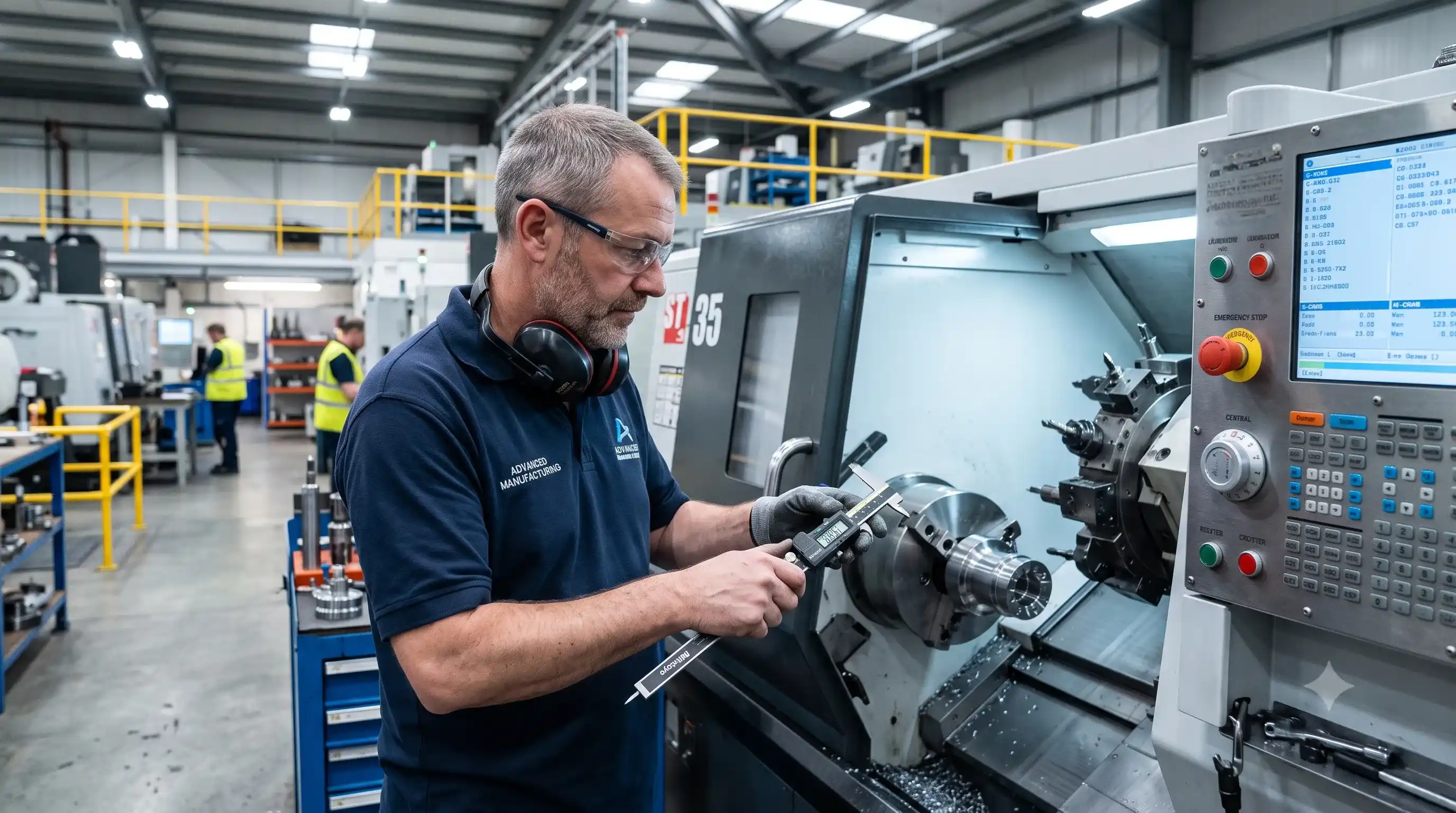
Local CNC machining services in Australia carry higher rates than offshore alternatives. Skilled CNC machinists are paid under an industry award, and overtime, superannuation and payroll tax further increase the fully burdened labour cost — considerably more than equivalent labour in Southeast Asian manufacturing hubs. Machine tool capital costs are also significant, and these costs are recovered through shop rates.
What you get in return: Australian-based quality control, same-day communication, no IP risk, and lead times measured in days rather than weeks.
3. The Hidden Costs of Offshore Procurement
Offshore quotes don't include a line item for "things that go wrong." But things do go wrong, and those costs fall on the buyer. The build-up from ex-works to your loading dock includes ocean freight and port handling, import duty, tax on the customs value plus duty and freight, customs broker fees, and domestic transport — on a modest order, these can add up to a meaningful part of the total before a single part is inspected.
Ocean freight from major Asian ports to Australia typically takes 3 to 6 weeks in transit. Add production scheduling and customs clearance, and a realistic offshore delivery window runs to roughly 8 to 14 weeks for a new order — longer for specialised components. To keep production running during that wait, businesses sourcing offshore must carry buffer stock, which carries its own cost in warehouse space, insurance, and capital tied up — plus the risk that stock becomes obsolete if a design changes mid-production, which is common in custom engineering. A local CNC machining service can pause, update its settings and resume within a day instead.
Out-of-spec parts are expensive to resolve: remanufacture means another long wait, local rework uses up the original saving, and scrapping means a full loss on the part, freight and duty already paid. Non-compliant raw material is also hard to detect without lab testing — Australian shops keep traceability records and mill certificates on request; many offshore low-cost suppliers do not.
4. Two Scenarios: Where Local and Offshore Each Make Sense
The right answer depends on the part, the order size and how the project is running. Picture a small batch of complex aluminium structural brackets needing tight tolerances, 5-axis milling and an anodised finish: an offshore quote may look cheaper on paper, but it also means a long wait, no defence-grade traceability, extra inspection on arrival, and the risk of a production stoppage if any part fails. For most engineering firms running active projects, sourcing this locally is the lower-risk choice.
Now picture a large batch of simple stainless steel threaded bushings, turned from bar stock to standard tolerances. Here, the offshore saving is real: setup and freight costs are spread across many more units, the design is locked, and quality risk is lower for a simple, standard part — provided lead times are planned well ahead and no design changes are expected. There's no single winner; it depends on the component, the volume and the project constraints.
5. When Local CNC Machining Wins on Total Cost
Local wins in four situations. For low-volume and prototype orders, setup and programming fees make up a large share of the total part cost, and offshore suppliers charge those fees too before adding freight, duty and a long wait on top.
For tight tolerances and complex geometry, quality risk rises sharply as tolerances tighten, and reworking an out-of-spec offshore batch wipes out any saving. Australian shops with in-house quality control catch errors before parts leave the workshop.
For active designs, offshore machining is high-risk — a superseded design becomes scrap the moment a revision arrives, after freight and duty are already paid. A local shop can pause a job and carry on the same day. And for defence, regulated or IP-sensitive work, offshore isn't an option — offshore vendors cannot hold DISP accreditation.
6. When Offshore Makes Sense
- High unit volumes, where per-unit freight and setup costs shrink and labour cost becomes the deciding factor
- Simple geometry and standard tolerances, which reduce quality risk
- A locked design, with no pending revisions
- A long planning horizon, so buffer stock isn't needed to cover the transit window
- Sourcing that qualifies for a free trade agreement, improving the offshore total cost
The bushings example above fits all of these — the offshore saving is real and defensible. The complex bracket example fits none of them, and the saving disappears under a full total-cost review.
7. A Simple Decision Framework
Run each component through these questions, in order, and stop when you reach a clear answer. Is the work defence, regulated or IP-sensitive? If yes, source locally from a DISP-accredited supplier — offshore isn't available. Is the order volume small? If yes, local will almost always deliver a lower or comparable total cost once freight and setup are included.
Does the part need tight tolerances or complex geometry? If yes, local precision machining is the lower-risk choice — the offshore saving rarely survives a single non-conforming batch. Is the design locked and the lead time flexible? If the answer to the first three is no, and the design is stable with plenty of lead time, offshore high-volume machining may offer genuine savings — but work through the full landed cost first. If in doubt, get quotes from both. A CNC machining service that turns quotes around quickly makes the comparison fast and easy.
Local CNC Machining at Southside Engineering
Southside Engineering has been machining precision components for Australian manufacturers since 1973. Our Mordialloc workshop is 100% Australian owned and operated, with tolerances to ±0.01mm, 24-hour rapid prototyping, and quotes within 4 business hours.
We offer CNC machining, CNC milling and CNC turning across steel, stainless steel, aluminium, brass, copper and engineering plastics, plus high-volume machining, repetition engineering and assembly and production — with Australian-based quality control and material traceability, delivering across Melbourne and nationwide. We work with sectors including defence, mining, fabricators and general manufacturing and prototyping.
Call us on (03) 9587 0405 or request a quote.