100% Australian Owned & Operated

Southside Engineering Blog

CNC machining guides, manufacturing insights, and real project case studies from our Mordialloc machine shop.
Thank you! Your submission has been received!
Oops! Something went wrong while submitting the form.
Machined metal brackets prepared for large-scale construction assembly under urgent production timelines.
Case Studies

Big Build Rush Order

Southside Engineering CNC-machined and delivered 82 custom steel brackets overnight in Melbourne — enabling a civil construction team to stay on schedule with zero downtime and precise, high-quality parts.

The Challenge

A major civil construction firm was forced to halt work when custom brackets and spacers for a key installation failed to arrive on schedule.
The missing components left crews idle and threatened costly project delays on a tight infrastructure deadline.

The client needed 82 precision-machined steel parts produced urgently — and delivered to site before work resumed the next morning.

Our Approach

Southside Engineering immediately reprioritised its production schedule to accommodate the emergency order.

Our team:

  • Reviewed the supplied CAD files and optimised toolpaths for efficient, high-speed machining.
  • Programmed multiple CNC machining centres to run the job concurrently overnight.
  • Used high-strength steel stock to ensure long-lasting structural integrity.
  • Carried out quality inspection and batch verification to maintain uniform accuracy across all 82 parts.
  • Coordinated direct early-morning delivery to site to meet the client’s install window.

By leveraging our high-volume CNC machining workflow, we completed, finished, and dispatched all parts within 12 hours of receiving the order.

The Outcome

The construction team received their order at sunrise and began installation immediately. All parts fit perfectly, enabling the project to stay on schedule without a single delay.

Results:

  • 82 precision parts machined and delivered overnight
  • Zero project downtime
  • Accurate fit ensured seamless on-site installation
  • Positive client feedback for responsiveness and quality

Key Takeaway

When deadlines are critical, Southside Engineering’s rapid CNC manufacturing services keep projects moving.
Our ability to prioritise urgent jobs, run multiple machines simultaneously, and maintain tight-tolerance precision (±0.01mm) ensures fast turnaround without compromising quality.

From infrastructure builds to emergency replacement parts, Southside delivers reliable, Australian-made CNC manufacturing — on time, every time.

Metric Detail
Industry Civil Construction & Infrastructure
Problem Project delayed waiting on custom brackets and spacers
Solution 82 precision CNC-machined parts completed overnight
Turnaround 24 hours
Result On-site at sunrise, zero delay to project schedule
Southside Team
14 Nov 2025
0 min read
Big Build Rush Order
Close-up of 3D printer extruder highlighting precision components for CNC machining and CNC manufacturing applications.
Manufacturing

CNC Engineering Services Explained: Complete Guide to Custom Precision Manufacturing in Melbourne

Melbourne is Australia’s leading hub for high-value precision manufacturing, supporting defence, medical, and other innovation. This guide breaks down CNC engineering services in Melbourne, from multi-axis machining and material selection to quality standards.

Introduction

Melbourne has changed from a twentieth-century automotive manufacturing hub into Australia's leading centre for high-value precision engineering. Victoria now contributes around $8.4 billion to the Australian economy through advanced manufacturing, supporting over 24,300 specialised workers in aerospace and defence alone.

This guide explains the full range of CNC engineering services available in Melbourne, from multi-axis CNC milling and turning to quality standards and material options. Whether you are looking for a CNC machine shop in Melbourne or want to understand how precision manufacturing works, this guide will help you find the right partner for your project.

Summary

Key Takeaways:
  • CNC engineering services use computer-controlled precision to achieve micron-level accuracy that is impossible with manual machining methods.
  • Multi-axis CNC milling (3, 4, and 5-axis) and CNC turning enable complex geometries for aerospace, medical, and defence applications.
  • Melbourne CNC machine shops work across a wide range of materials, from aluminium alloys and stainless steel to titanium and biocompatible polymers like PEEK.
  • Quality standards, including ISO 9001, AS9100D, and AS/NZS 5131 ensure full traceability and compliance for regulated industries.
  • Design for Manufacturability (DFM) support reduces costs by improving part geometry during the design phase, before CNC machining begins.

Understanding CNC Engineering Services

CNC (Computer Numerical Control) machining is a process where pre-programmed software controls factory tools and machinery to remove material from a workpiece. Unlike manual machining, CNC processes run automatically at high speed with a level of accuracy and repeatability that cannot be achieved by hand.

Core CNC Machining Processes

CNC milling uses rotating cutting tools to remove material from a fixed workpiece. It is used for complex parts, housings, and detailed surface finishes. CNC turning spins the workpiece against a stationary cutting tool to produce cylindrical components such as shafts, pins, and flanges. Modern CNC turning centres in Melbourne often include live tooling, which allows the lathe to drill or mill while the part stays in the chuck. This removes the need to transfer the part to a separate machine and reduces the chance of tolerance errors building up across setups.

Specialised CNC Capabilities

Swiss-style CNC turning supports long, slender parts using a sliding headstock. Melbourne machine shops in Mordialloc produce micro-components with diameters as small as 1mm held to +-0.002mm. Electrical Discharge Machining (EDM) handles materials too hard for cutting tools, using controlled electrical sparks to erode hardened steels and titanium without introducing heat stress.

Multi-Axis CNC Milling and Turning Capabilities

The number of axes a CNC machine operates on defines what can be manufactured without manual repositioning. 3-axis CNC milling covers brackets and housing plates but needs multiple setups for complex parts. 4-axis adds a rotational A-axis for undercuts and angled features. 5-axis adds a B-axis so the tool can approach the workpiece from any direction, enabling complex organic shapes like turbine impellers. Southside Engineering uses advanced 5-axis systems for defence work where geometric precision is required for certification. CNC turning is best for cylindrical and symmetrical parts, while Swiss-style turning handles extreme precision on small, slender components.

Process Axis Capability Best Used For
3-Axis CNC Milling X, Y, Z Cost-effective production of prismatic parts
4-Axis CNC Milling X, Y, Z + A Angled features and undercuts, fewer setups
5-Axis CNC Milling X, Y, Z + A, B Complex organic shapes, single-setup accuracy
CNC Turning X, Z + Spindle Cylindrical and symmetrical components
Swiss CNC Turning Sliding Headstock Extreme precision for small, slender parts

Need multi-axis CNC milling or CNC turning in Melbourne? Get a quote from Southside Engineering within 4 hours.

Material Options and Machinability

Choosing the right material for CNC engineering means balancing mechanical performance, machinability, and cost. Melbourne CNC machine shops have deep experience across a wide range of metals and engineering plastics.

  • Aluminium Alloys (6061-T6, 6063, 7075) - The most widely processed metal in Melbourne CNC machine shops. High strength-to-weight ratio and easy to machine at speed. Default choice for aerospace and automotive applications.
  • Stainless Steel (303, 304, 316L, 17-4 PH) - Used in medical and marine applications. Grade 316L offers the best corrosion resistance for implants and marine environments.
  • Titanium (Grade 5, Ti6Al4V) - For mission-critical aerospace and defence parts. Low thermal conductivity makes it challenging to machine. Southside Engineering has developed specific process parameters to handle titanium safely.
  • Engineering Plastics (PEEK, POM, Nylon) - Used where metals are not suitable. PEEK is biocompatible and common in medical applications. Offers low friction, chemical resistance, and high dielectric strength.

Industry Applications and Compliance Standards

Melbourne's CNC engineering sector serves some of the most regulated industries in the world. Success requires not just technical capability, but a strong commitment to quality management systems and the right certifications.

Defence and National Security

Victoria has over 400 businesses supplying the Australian Defence Organisation. CNC machining companies producing components for land vehicles, maritime platforms, and aerospace systems must comply with AS9100D and ISO 9001:2015. Parts must meet build-to-print specifications and withstand extreme heat, vibration, and corrosive conditions.

Aerospace and Space Systems

Melbourne aerospace CNC manufacturing feeds into global supply chains. Turbine blades and aerostructure components require 5-axis CNC milling for the tight tolerances needed for flight safety. The growth of Australia's space sector has added demand for micro-machining and specialist materials that survive extreme thermal cycling.

Healthcare and Medical Technology

Melbourne's medical technology cluster produces orthopaedic screws, dental implants, and miniature valve components using Swiss-style CNC turning. Surface finishes as fine as Ra 0.2 micron are required for biocompatibility and to reduce the risk of infection or mechanical failure.

Quality Management and Inspection

In precision CNC manufacturing, verifying part geometry is just as important as machining it. Melbourne CNC engineering firms invest heavily in metrology to give clients full confidence that every part meets its specification.

Coordinate Measuring Machines (CMM)

CMMs use high-precision probes to map the X, Y, and Z coordinates of a part's surfaces, verifying features that cannot be checked with hand tools. Leading Melbourne CNC machine shops use CMM systems with repeatable measurement accuracy down to 2 microns. These systems are integrated into ISO 9001 or AS9100 quality management systems, providing a full traceability record from raw material certificate through to final inspection report.

Australian Standards and Technical Governance

Victorian CNC manufacturers also follow AS/NZS 5131:2016 for steel fabrication tolerances and AS/NZS 1554 for welding procedures and non-destructive testing. These standards ensure Melbourne-made parts are safe, durable, and compatible with Australian infrastructure requirements.

Looking for a CNC machine shop in Melbourne with full quality management? Contact Southside Engineering.

Design for Manufacturability (DFM) and Common Challenges

DFM brings production knowledge into the design phase to simplify CNC manufacturing and reduce costs. Key principles: apply tight tolerances (+-0.01mm) only to critical mating surfaces, use +-0.1mm as the default, keep pocket depth to no more than four times its width, and maintain minimum wall thickness of 0.5mm for metals and 1.0mm for plastics. Every extra 0.01mm of tolerance beyond what is needed adds 20-50% to machining time.

Common pitfalls to avoid: choosing materials based only on mechanical properties without thinking about machinability (consult your CNC engineering partner early); not specifying Ra surface finish values on drawings (use Ra 3.2 micron as standard, Ra 0.8 micron for precision, Ra 0.4 micron only for sealing or medical surfaces); and failing to define inspection requirements at the quoting stage. State upfront whether you need CMM reports, material certifications, or compliance with ISO 9001, AS9100D, or ISO 13485 to avoid delays later.

Southside Engineering provides full DFM reviews and material guidance before CNC manufacturing begins.

Conclusion

Melbourne's CNC engineering sector represents one of the most capable precision manufacturing environments in Australia. From multi-axis CNC milling of complex aerospace components to Swiss-style CNC turning for medical micro-components, the city's machine shops are equipped with the technology, materials, knowledge, and quality systems to handle the most demanding projects.

Why Choose Southside Engineering

Since 1973, Southside Engineering has been part of Melbourne's precision manufacturing community, based in Mordialloc at the heart of Victoria's manufacturing corridor. We offer multi-axis CNC milling (3, 4, and 5-axis), CNC turning with live tooling, Swiss-style CNC turning for micro-components, material expertise across aluminium, stainless steel, titanium, and engineering plastics, and full quality management aligned with ISO 9001 and Australian standards. Our +-0.01mm precision capability serves defence, aerospace, medical, mining, and transport sectors, with complete end-to-end service from design consultation through to finishing.

Ready to start your precision manufacturing project? Submit your CAD files or PDF drawings for a quote within 4 hours. Visit SouthSide Engineering.

Southside Team
24 Feb 2026
0 min read
CNC Engineering Services Explained: Complete Guide to Custom Precision Manufacturing in Melbourne
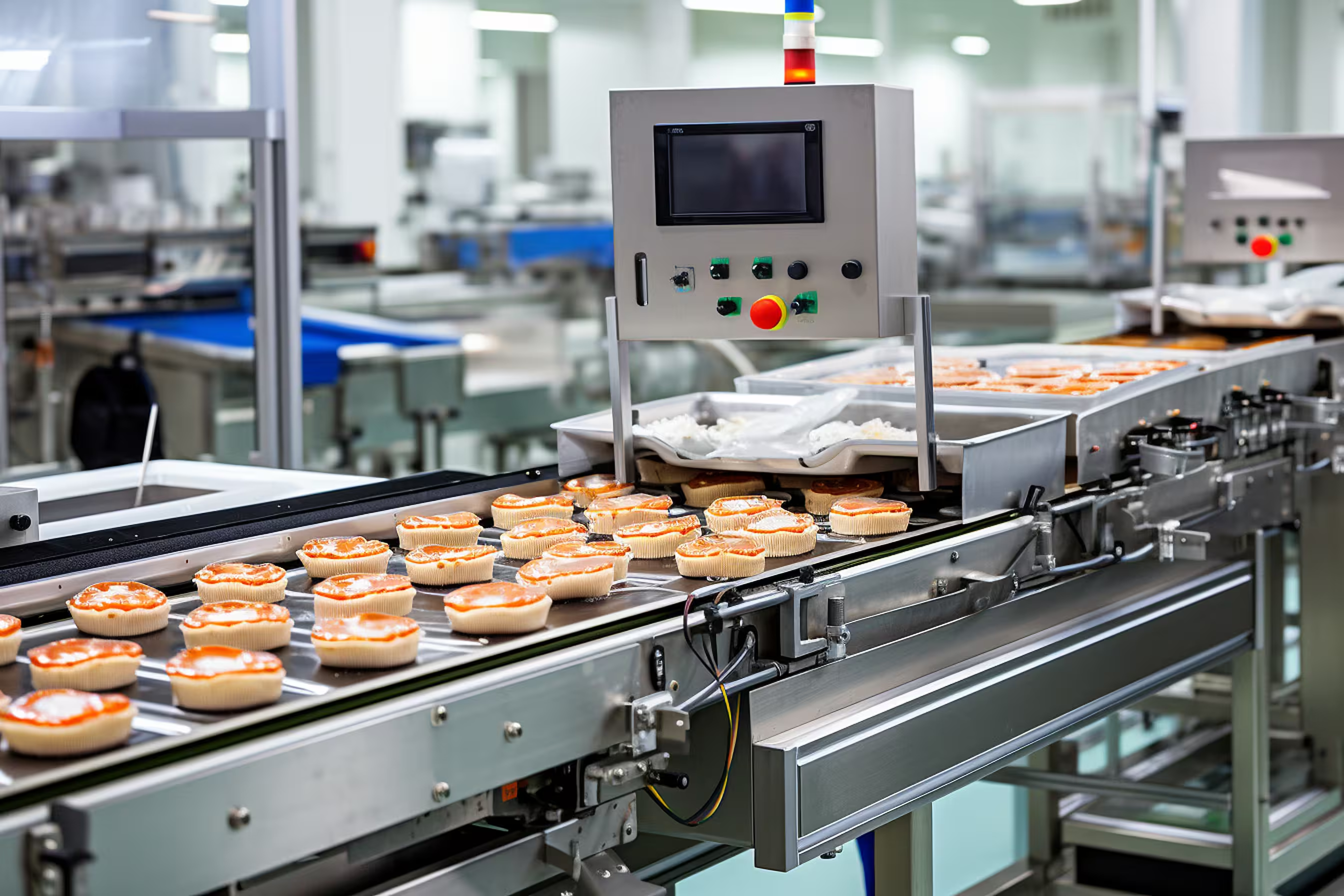
Automated food production conveyor line with stainless steel equipment and control panel in a hygienic manufacturing facility
Industries

CNC Machining for Food and Beverage Equipment: Materials, Hygiene and Compliance

Food-grade components leave no room for contamination, corrosion or compromise. Here’s what your CNC machining partner needs to get right.

Introduction

Food and beverage manufacturing is one of the most demanding sectors for precision metal machining. Every component that touches food, liquid or steam must be made from approved materials, machined to surface finishes that prevent bacterial harbourage, and built to withstand daily exposure to high-pressure wash-downs, caustic cleaning chemicals and thermal cycling.

For food equipment manufacturers across Australia, finding a CNC machining services provider — whether you’re searching for CNC Melbourne specialists or CNC machining Australia-wide — that understands these requirements is critical. A general-purpose machining manufacturer can produce a part to tolerance, but if the material grade is wrong, the surface is too rough, or the internal geometry traps residue, the component becomes a food safety liability.

This guide covers the key requirements for CNC machining food and beverage equipment components, from material selection and surface finish standards to common parts and compliance considerations. It’s written from our experience as a CNC machining Melbourne workshop that has supplied food-grade components to processors, OEMs and equipment builders for over 50 years.

Summary

Key Takeaways

  • 316 stainless steel is the industry standard for food-contact CNC components, offering superior resistance to chlorides, acids and CIP cleaning chemicals.
  • Surface finish matters as much as material choice — food-contact surfaces typically require Ra 0.8 μm or better to prevent bacteria accumulating in micro-crevices.
  • Engineering plastics like PEEK, Acetal and UHMWPE are used for non-metallic food-contact components including guides, rollers, wear strips and seals.
  • A CNC machinist working in the food and beverage space needs to understand both the machining tolerances and the hygiene context behind each component.
  • Australian food manufacturers must comply with FSANZ and HACCP requirements, and the materials and finishes used in machined components play a direct role in meeting those standards.

1. Why CNC Machining Matters for Food and Beverage

Food processing and beverage production lines are built from hundreds of precision components — valve bodies, pump housings, fittings, nozzles, shafts, guides and wear parts that keep product moving from mixing through to packaging. These parts operate under constant exposure to water, steam, food acids, caustic wash chemicals and mechanical wear. They need to hold precise dimensions, seal reliably, resist corrosion, and clean up completely during every wash cycle.

Off-the-shelf parts rarely meet the specific dimensional, material or hygiene requirements of custom food processing equipment. That’s where CNC manufacturing comes in. CNC milling and CNC turning allow manufacturers to produce components that are purpose-built for the application — machined from the correct food-grade material, to the exact tolerances required, with surface finishes that support hygienic operation from day one.

The machining industry serves food and beverage in two main ways: producing components for OEMs building new processing equipment, and machining replacement or upgraded parts for existing production lines. In both cases, the requirements go well beyond what a standard metal machining job demands. The machine shop needs to understand not just how to cut the part, but why the material, finish and geometry matter for food safety.

2. Materials for Food-Grade Components

Material selection is the foundation of every food-safe machined component. The material must resist corrosion from food acids and cleaning chemicals, maintain structural integrity under thermal cycling, and in many cases meet specific regulatory requirements for food contact.

Stainless Steel: The Industry Standard

Stainless steel dominates food and beverage CNC machining for good reason. Its chromium content forms a passive oxide layer that resists corrosion, and the austenitic grades (300-series) are non-magnetic, weldable and well-suited to hygienic fabrication.

  • 316 stainless steel – the primary choice for food-contact surfaces in the machining industry. The added molybdenum gives it superior resistance to chlorides, organic acids, and CIP (Clean-in-Place) chemicals — the harsh alkaline and acidic solutions used to clean production lines without disassembly. If you’re machining components for dairy, brewing, sauce production or pharmaceutical processing, 316 is the standard
  • 316L (low carbon) – the preferred option for welded assemblies. The reduced carbon content prevents carbide precipitation at weld zones, which would otherwise create weak points susceptible to intergranular corrosion
  • 304 stainless steel – a cost-effective alternative for non-contact structural components, equipment frames, mounting brackets and housings where the part doesn’t directly touch food

One practical note: stainless is tougher on tooling than aluminium or mild steel. It work-hardens during cutting, generates more heat, and requires slower feed rates. This means higher per-part costs, but for food-contact applications, the material cost is a non-negotiable part of compliance.

Engineering Plastics for Food Applications

Not every food-grade component needs to be metal. Engineering plastics are widely used in food processing for guides, rollers, wear strips, seals, bushings and conveyor components where low friction, chemical resistance or weight savings matter.

  • PEEK – handles continuous temperatures up to 250°C, is autoclavable, chemically inert and FDA-compliant. Used for valve seats, seals and components in high-temperature sterilisation environments
  • Acetal (Delrin / POM) – low friction, excellent dimensional stability and good chemical resistance. A practical choice for conveyor guides, rollers and metering components
  • UHMWPE – extremely wear-resistant, self-lubricating and FDA-approved for food contact. The go-to for guide rails, wear strips and conveyor components in meat, poultry, bakery and general food processing
  • Nylon (food grade) – strong, tough and self-lubricating. Used for gears, bushings and spacers in packaging and bottling machinery

Need food-grade CNC machining in Melbourne? Get a quote from Southside Engineering →

3. Surface Finish: Where Hygiene Starts

In food and beverage manufacturing, surface finish is a hygiene requirement, not a cosmetic preference. Rough or porous surfaces create micro-crevices where bacteria, mould and food residue can accumulate and resist cleaning.

The industry-standard measure is Ra (Roughness Average) — the arithmetic average of the peaks and valleys across a surface, measured in micrometres (μm). For food-contact stainless steel surfaces, the benchmark is:

  • Ra 0.8 μm or better – the widely accepted standard for food-contact surfaces, referenced in 3-A Sanitary Standards and adopted across most Australian dairy, beverage and food processing operations
  • Ra 0.4 μm or finer – required in some dairy, pharmaceutical and high-care processing environments where even stricter hygiene control is necessary

Achieving these finishes is a two-stage process. First, the CNC machining operation itself needs to be set up correctly. Then, secondary finishing processes bring the surface to its final specification.

Beyond surface roughness, the geometry of the part also matters for hygiene. Internal bores, channels and cavities should be machined with smooth, crevice-free transitions to ensure complete drainage and effective CIP cleaning. Dead legs, sharp internal corners and pockets that trap fluid are all design features that a food-aware CNC machinist in Melbourne will flag before production begins.

4. Common Food and Beverage Components We Machine

Southside Engineering produces a wide range of CNC-machined components for food and beverage processing equipment. These include both direct food-contact parts machined from 316 stainless or food-grade plastics, and structural components that support processing lines.

Valves and Flow Control

  • Valve bodies and seats – precision-machined from 316 stainless for leak-free operation in liquid, steam and CIP circuits. Sealing surfaces finished to Ra 0.8 μm or better
  • Fittings and adapters – custom tri-clamp compatible fittings, reducers and adapters machined to sanitary standards

Pumps and Mixing

  • Pump housings and impellers – close-tolerance components for sanitary pumps used in dairy, beverage and sauce production
  • Mixer shafts and agitator components – CNC-turned shafts with polished surfaces for hygienic mixing vessels

Filling and Packaging

  • Filling nozzles and dosing components – precision-bored nozzles for accurate, repeatable filling in bottling and sachet packaging lines
  • Conveyor guides and wear strips – UHMWPE and Acetal components that reduce friction and extend belt life in packaging lines

Cutting and Processing

  • Cutting blades and slicing fixtures – hardened stainless steel components for food cutting, portioning and trimming equipment
  • Inspection and mounting brackets – structural components for sensors, cameras and quality control equipment on production lines

Whether you need a single replacement part machined urgently to get a line running again, or a production run of custom components for new equipment, our CNC machining services cover the full range of food and beverage work.

5. Compliance and Standards in Australia

Food and beverage manufacturers in Australia operate within a regulatory framework that directly affects what materials and finishes are acceptable for processing equipment. While the CNC machining manufacturer isn’t responsible for certifying the end product, the materials and finishes we use play a direct role in compliance.

  • Food Standards Australia New Zealand (FSANZ) – sets the overarching regulatory framework for food safety in Australia, including requirements for materials that come into contact with food during processing
  • HACCP (Hazard Analysis Critical Control Points) – the systematic food safety management approach used by most Australian food manufacturers. HACCP principles influence equipment design, material selection and surface finish specifications
  • 3-A Sanitary Standards – widely referenced in Australia for equipment design, surface finish requirements (Ra 0.8 μm maximum for food-contact surfaces) and cleanability criteria
  • AS 4674:2004 – the Australian standard for the construction of equipment for the food industry, covering design, materials and fabrication requirements
  • FDA 21 CFR – relevant for Australian manufacturers exporting to the US or using food-contact plastics that reference FDA compliance

In practice, what this means for any machining manufacturer working in the food space is straightforward: use the specified material grade, machine to the specified surface finish, avoid design features that trap food residue, and document what was done. As a CNC machining services manufacturer with decades of food-industry experience, Southside Engineering can work from your compliance-driven specifications or advise on material and finish options.

6. Finishing and Post-Processing

The right finishing process protects the component, ensures hygiene compliance and extends service life. For food and beverage components, finishing isn’t optional — it’s part of the specification.

  • Electropolishing – the gold standard for food-contact stainless steel. It electrochemically removes the outer layer of metal, creating an ultra-smooth, passive surface that resists both corrosion and bacterial adhesion
  • Passivation – a chemical treatment that removes free iron from the stainless steel surface after machining, restoring the chromium-rich passive layer that gives stainless its corrosion resistance
  • Mechanical polishing – achieves mirror or satin finishes for components where a specific Ra value is required or where the part is visible on the production line
  • Bead blasting – creates a uniform matte texture for non-contact surfaces such as equipment housings and frames
  • As-machined (plastics) – many food-grade plastics are used without additional finishing. UHMWPE, Acetal and PEEK have inherently low porosity and chemical resistance that make them suitable as-machined

Need food-grade finishing on CNC components? Talk to Southside Engineering about your requirements →

7. What to Look for in a Food-Grade CNC Machinist

Not every machine shop is set up to handle food and beverage work. If you’re sourcing CNC machining near me for food-grade components, here’s what separates a capable food-industry machining partner from a general-purpose shop:

  • Material knowledge – they should discuss 316 vs 304, explain why 316L matters for welded assemblies, and know which plastic grades are FDA-compliant
  • Surface finish capability – they can achieve and verify Ra 0.8 μm or better, and understand why it matters for hygiene
  • Finishing partnerships – if they don’t do electropolishing or passivation in-house, they should have established relationships with finishing suppliers
  • Design awareness – they’ll flag potential hygiene issues — dead legs, sharp internal corners, trapped cavities — before machining begins
  • Traceability – for compliance-sensitive work, they can provide material certificates and documentation
  • Consistent quality on repeat orders – your CNC machining services provider should maintain setup records via [[${L.repetition}|repetition engineering]] so that every batch matches the first

8. Why a Local Melbourne Machine Shop Matters

For food and beverage manufacturers, having a CNC machining partner nearby makes a tangible difference. Production lines don’t wait. When a pump housing fails or a filling nozzle wears out, the cost isn’t just the replacement part — it’s the downtime on the line while you wait for it.

A local CNC machinist Melbourne businesses can visit means faster turnaround on urgent replacement parts, the ability to inspect components in person, and direct communication when specifications change mid-job. For anyone searching for CNC machining near me, proximity also means understanding the Australian regulatory environment, rather than working across time zones with a supplier unfamiliar with FSANZ or AS 4674.

Southside Engineering is based in Mordialloc, in Melbourne’s south-east manufacturing corridor. We’ve provided CNC machining Melbourne manufacturers rely on since 1973 — over 50 years of CNC machining Australia’s food-grade components. We hold tolerances to ±0.01 mm, offer 24-hour prototyping for urgent breakdowns, and return quotes within 4 hours of receiving drawings.

9. Conclusion

CNC machining for food and beverage equipment demands more than dimensional accuracy. It requires the right material, the right surface finish, and an understanding of why those choices matter for food safety and regulatory compliance. From 316 stainless steel valve bodies finished to Ra 0.8 μm, to UHMWPE conveyor guides that handle years of daily wash-downs, every component needs to be machined with hygiene in mind.

The difference between a general metal machining shop and a food-industry capable one comes down to knowledge and attention. Material selection that accounts for corrosion from CIP chemicals. Surface finishes that prevent bacterial harbourage. Design feedback that flags hygiene risks before the first cut. And consistent quality across every batch.

Southside Engineering has been providing CNC machining services to Australian food and beverage manufacturers for over five decades, and we’re proud to be a trusted machining Australia partner for some of Melbourne’s most recognised food brands. If you have a food-grade component that needs to be machined right, send us your drawings. We’ll come back with a material recommendation, surface finish specification and a quote — within 4 hours.

Have a food or beverage equipment project? Request a quote from Southside Engineering →

Southside Team
23 Apr 2026
0 min read
CNC Machining for Food and Beverage Equipment: Materials, Hygiene and Compliance
Automated production line with machined conveyor bearing housings ensuring precise and durable performance.
Case Studies

Conveyor Bearing Housings

Southside Engineering CNC-machined 36 upgraded alloy bearing housings within 48 hours, restoring a packaging plant’s conveyors to full operation with stronger, more durable components designed to prevent future failures.

The Challenge

A packaging plant came to a halt when 36 bearing housings cracked across several conveyor systems, bringing production to a standstill.
The damage was caused by material fatigue and thin wall sections in the original cast parts — and new OEM replacements would take weeks to arrive.

The maintenance team needed stronger, longer-lasting replacements, machined to exact dimensions, and installed within 48 hours to avoid extended downtime.

Our Approach

Southside Engineering took immediate action to replicate and improve the existing design.

Our team:

  • Inspected the damaged housings and recorded critical dimensions and bearing seat tolerances.
  • Modelled the parts in CAD to identify weak points and increase wall thickness for greater strength.
  • Machined 12 new housings from upgraded alloy steel, improving both durability and impact resistance.
  • Conducted CNC milling and boring with ±0.01mm accuracy to ensure perfect bearing fit.
  • Delivered and assisted with installation within 48 hours of receiving the job.

Each part was manufactured and inspected under Australian-based quality control, ensuring consistency across all housings.

The Outcome

The new housings were installed and operational within two days — eliminating the risk of future cracking and improving long-term performance.

Results:

  • 36 upgraded alloy housings machined and installed within 48 hours
  • Improved design with thicker wall sections for durability
  • Perfect bearing alignment and fit across all conveyors
  • Production fully restored, zero follow-up issues reported

Key Takeaway

Southside Engineering’s CNC machining and redesign services help manufacturers extend the life of critical components while improving reliability and uptime. By combining precision machining, material expertise, and fast delivery, we provide industrial clients with stronger, smarter solutions — not just replacements.

Metric Detail
Industry Packaging & Material Handling
Problem 36 cracked bearing housings halted conveyor production
Solution CNC-machined replacements from stronger alloy with improved design
Turnaround 48 hours
Result Production restored, longest-lasting housings to date
Southside Team
14 Nov 2025
0 min read
Conveyor Bearing Housings
Industrial conveyor shaft system undergoing precision machining and alignment for production restoration.
Case Studies

Conveyor Shaft Emergency

Southside Engineering rapidly CNC-machined a high-precision replacement drive shaft for a factory conveyor, restoring full production within 8 hours. The new alloy steel shaft delivered improved strength, alignment, and reliability — minimizing downtime and keeping operations running smoothly.

The Challenge

A factory foreman contacted Southside Engineering after a main conveyor drive shaft cracked during a production run, halting an entire manufacturing line. With production downtime costing thousands per hour, the team needed a precision-machined replacement shaft urgently — strong enough to handle torque and alignment stresses, and manufactured to tighter tolerances than the failed original.

The challenge: restore full production within the same day without compromising on balance, precision, or fit.

Our Approach

Southside Engineering immediately assessed the failure and took dimensional measurements provided remotely by the client.

Our team:

  • Verified shaft geometry and bearing seat tolerances from the provided dimensions.
  • Selected a high-grade alloy steel for superior tensile strength and rotational balance.
  • CNC-turned the new shaft to ±0.01mm precision, ensuring perfect fit within existing housings and couplings.
  • Performed dynamic balancing and quality inspection to confirm smooth operation.

The new drive shaft was completed that same afternoon, ready for immediate installation during the night shift.

The Outcome

Our client’s maintenance crew fitted the new shaft overnight, bringing the conveyor line back online before management even knew there was a breakdown.
The replacement performed flawlessly, running smoother and more efficiently than before.

Results:

  • New CNC-turned shaft delivered in under 8 hours
  • Line operational before next shift
  • Improved shaft precision and alignment tolerance
  • 100% Australian-machined and quality-checked

Key Takeaway

When unplanned downtime strikes, Southside Engineering’s rapid CNC machining services in Melbourne keep production moving. By combining CNC turning expertise, same-day manufacturing, and Australian-based quality control, we help factories and industrial operators recover fast — with stronger, more precise components that last.

Quick Summary

Metric Detail
Industry Manufacturing & Material Handling
Problem Conveyor drive shaft cracked mid-production
Solution CNC-turned replacement shaft machined to ±0.01mm tolerance
Turnaround Same day
Result Production restored within 8 hours, zero long-term downtime

Southside Team
14 Nov 2025
0 min read
Conveyor Shaft Emergency
Row of CNC lathes and machining equipment in a precision manufacturing workshop
Manufacturing

Finding a CNC Machine Shop That Understands Fabrication Workflows

Not every machine shop understands how fabricators work. Here’s how to find one that fits into your workflow instead of slowing it down.

Introductions

Fabricators don’t just need machined parts. They need machined parts that arrive on time, fit their assemblies on the first attempt, and come from a machine shop that understands how fabrication projects actually flow. The wrong machining partner creates bottlenecks — late parts, tolerance mismatches, and rework that blows out project timelines and margins.

This guide is for fabrication businesses looking for a CNC machining partner in Melbourne. It covers what to look for, what to avoid, and how the right machine shop integrates with your workflow rather than disrupting it. It’s based on over 50 years of CNC machining services delivered alongside Australian fabricators from our Mordialloc workshop.

Summary

Key Takeaways

  • Fabricators need a CNC machining partner who understands that machined components are one piece of a larger assembly — not a standalone product.
  • The right machine shop works from your CAD files, PDF drawings, or even hand sketches, and delivers parts that integrate with your fabrication workflow without rework.
  • Turnaround time and communication are as important as tolerances. A machine shop that takes two weeks for a simple flange can hold up an entire project.
  • Local proximity matters. A Melbourne-based CNC machinist means same-day pickups, face-to-face problem-solving, and faster response to urgent or revised orders.
  • The best CNC partners for fabricators offer flexible batch sizes, consistent quality across repeat orders, and the ability to handle rush jobs without sacrificing accuracy.

1. Why Fabricators Need a Dedicated CNC Machining Partner

Most fabrication shops are equipped for cutting, welding, bending and assembling. But when a project calls for a precision-machined flange, a threaded adapter, or a close-tolerance mounting plate, those parts typically need to go to a CNC machine shop. That’s the reality of modern metal machining in the fabrication industry — not every operation can be done in-house.

The challenge is that machining is often on the critical path. A fabricated frame might be ready to assemble, but if the machined mounting brackets haven’t arrived yet, the entire job stalls. This is why having a reliable CNC machining services provider — not just any machine shop, but one that understands your timelines and processes — is essential for keeping fabrication projects moving.

Southside Engineering has worked alongside Melbourne fabricators for over 50 years, providing CNC milling and CNC turning services that slot directly into fabrication project timelines. We understand that your machined parts aren’t the end product — they’re a component of a larger build.

2. What to Look for in a CNC Machine Shop

Not all machine shops are a good fit for fabrication work. Here are the key factors that separate a machining partner from a machining vendor in the machining industry:

  • Fabrication awareness – the shop understands that your machined part is going into a welded assembly. They know that a mounting plate needs to match hole patterns on a fabricated frame, and they check for potential fit issues before machining
  • Flexible input formats – a good machining partner works from whatever you provide — CAD files (STEP, IGES, DXF), PDF drawings, marked-up sketches, or even a sample part for reverse engineering
  • Consistent tolerances – for fabrication work, ±0.01 mm to ±0.05 mm is typical. The shop must hold these tolerances consistently across repeat orders, not just on the first batch. This is where [[${L.repetition}|repetition engineering]] matters
  • Turnaround speed – simple components should be ready in 3 to 5 working days. Rush parts should be available within 24 to 48 hours through a [[${L.proto}|rapid prototyping]] service. If a shop can’t commit to timeframes, they’ll become your bottleneck
  • Material range – fabricators work across mild steel, stainless steel, aluminium, brass, copper and engineering plastics. A machining manufacturer that only works with one or two materials will limit your options
  • Communication – a responsive quoting process (ideally within 4 hours), clear lead time commitments, and proactive updates if anything changes during production
  • Quality consistency – parts must be right the first time. A shop that delivers out-of-tolerance parts or inconsistent batches creates rework and delays across your entire project

3. Common Problems with the Wrong Machining Partner

Fabricators who have worked with the wrong CNC machine shop will recognise these issues:

  • Late deliveries – the machined parts arrive after the rest of the assembly is ready, forcing the fabrication team to wait or work out of sequence
  • Tolerance drift on repeat orders – the first batch is perfect, but subsequent orders gradually drift out of spec because the shop doesn’t maintain setup records
  • No understanding of context – the machine shop treats every part as an isolated job. They don’t consider how the part fits into your assembly, which means they miss obvious issues like incompatible hole patterns or incorrect thread specifications
  • Slow quoting – waiting 3 to 5 days for a quote on a simple bracket means your project timeline is already slipping before the part is even made
  • Minimum order requirements – some CNC machining services providers only accept high-volume orders, leaving fabricators who need 5 or 10 pieces without a viable option
  • Poor communication – no updates on job progress, no notification of delays, and difficult to reach when you need to make a change or check on status

These problems compound. A single late delivery can push back an assembly deadline, which delays the entire project handover to your client. Over time, an unreliable machining partner erodes your margins and your reputation.

4. How a Good Machine Shop Integrates with Fabrication Workflows

The best CNC machining partners for fabricators don’t just make parts — they become an extension of your production process. Here’s what that looks like in practice:

Quoting and Planning

You send drawings or CAD files. The machine shop returns a quote within hours, not days, with a clear lead time. If there are potential issues with the design — such as tolerances that will increase cost unnecessarily or features that could be simplified — they flag them before production begins.

Production and Quality

Parts are machined to the agreed tolerances and inspected before dispatch. For repeat orders, the shop maintains setup records through repetition engineering processes so that every batch matches the first. If you order the same flange six months later, it fits identically.

Delivery and Flexibility

Standard turnaround is 3 to 5 working days. Rush orders can be turned around in 24 hours through our rapid prototyping service for urgent site or project needs. The shop handles single pieces through to production runs without requiring minimum order quantities that don’t suit fabrication project volumes.

Ongoing Relationship

Over time, a good machining partner learns your standards, your typical materials, and your project patterns. This reduces quoting time, eliminates repeated clarifications, and means your regular orders are processed faster because the shop already understands your requirements.

Southside Engineering operates as this kind of partner for fabrication businesses across Melbourne. We maintain job records for repeat orders, offer flexible batch sizes, and prioritise clear communication at every stage.

Looking for a CNC machining partner that fits your fabrication workflow? Get a quote from Southside Engineering →

5. The Components Fabricators Need Machined Most Often

From our decades of CNC manufacturing alongside Australian fabrication businesses, these are the components that come through our workshop most regularly:

  • Mounting plates and brackets – precision-drilled and tapped plates that bolt fabricated frames to equipment, structures or vehicles. Hole patterns need to match exactly
  • Flanges and adapters – machined from mild steel, stainless or aluminium to connect pipe runs, shafts or housings within fabricated assemblies
  • Shafts and pins – [[${L.turning}|CNC-turned]] shafts, pivot pins and axles machined to close tolerances for smooth rotation and reliable fit in fabricated frames
  • Bushings and spacers – small but critical components that maintain alignment and spacing between moving parts in fabricated equipment
  • Threaded components – custom studs, standoffs and threaded inserts that standard fasteners can’t replace
  • Wear parts – replaceable components like guide blocks, slide plates and wear strips machined from hardened steel, brass or engineering plastics
  • Jigs and fixtures – machined tooling used by the fabrication shop itself to hold, align and position work during welding and assembly

All of these components can be machined from a range of materials and finished with powder coating, zinc plating, anodising or other treatments depending on the application. We also offer assembly production services for fabricators who want components delivered ready to install.

6. Questions to Ask Before Choosing a CNC Partner

Before committing to a CNC machine shop, ask these questions to determine whether they’re a good fit for your fabrication work:

  • What is your standard turnaround time for simple machined components (flanges, brackets, plates)?
  • Can you work from PDF drawings as well as CAD files? What about hand sketches or sample parts?
  • What materials do you machine? Do you stock common grades of mild steel, stainless and aluminium?
  • Do you have a minimum order quantity, or can you handle single-piece and small-batch orders?
  • How quickly do you return quotes? Can I get a quote within 4 hours for straightforward parts?
  • Do you maintain setup records for repeat orders so that every batch is consistent?
  • Can you handle rush orders within 24 to 48 hours if a project timeline demands it?
  • What tolerances do you hold as standard? Can you achieve ±0.01 mm consistently?
  • Are you based locally? Can I visit the shop or arrange same-day pickup for urgent parts?

A machine shop that answers these questions confidently and backs them up with consistent delivery is the kind of partner that will support your fabrication business long term.

7. Why a Local Melbourne Machine Shop Matters

For fabrication businesses, having a CNC machining partner nearby makes a practical difference that goes beyond convenience. Fabrication projects move quickly, timelines are tight, and when you need a machined component to keep an assembly moving, waiting a week for an interstate or offshore supplier isn’t an option.

A CNC machinist Melbourne fabricators can rely on means same-day pickups, the ability to drop off a marked-up drawing and discuss it face-to-face, and faster resolution when something needs to change mid-job. When you’re searching for CNC machining near me, what you’re really looking for is a CNC Melbourne partner close enough to become part of your production rhythm.

Southside Engineering is based in Mordialloc, in Melbourne’s south-east manufacturing corridor. We’ve been providing CNC machining Melbourne fabricators depend on since 1973 — over 50 years of machining Australia’s fabrication components. We serve a broad range of industries, including heavy equipment, transport, construction, mining, marine and general manufacturing. Tolerances to ±0.01 mm, 24-hour prototyping, and quotes within 4 hours of receiving drawings.

8. Conclusion

Finding the right CNC machine shop is not about finding the cheapest quote. It’s about finding a machining partner that understands fabrication workflows, delivers on time, communicates clearly, and produces parts that fit your assemblies without rework. The right partner saves you time, protects your margins, and keeps your projects moving.

Southside Engineering has been that partner for Melbourne fabricators for over 50 years, from our machine shop in Mordialloc. As a CNC machining services manufacturer with deep fabrication experience, we’re set up to deliver whether you need a one-off flange or a regular supply of machined components. We work with mild steel, stainless, aluminium, brass, copper and engineering plastics — whatever your fabrication project calls for.

We’re a machining manufacturer that understands CNC machining Australia’s fabrication sector depends on — consistent quality, fast turnaround and clear communication. If you’re a fabricator looking for a reliable metal machining partner in Melbourne, send us your drawings. We’ll come back with a quote and a lead time you can build your project schedule around.

Need a reliable CNC machining partner for your fabrication work? Request a quote from Southside Engineering →

Southside Team
23 Apr 2026
0 min read
Finding a CNC Machine Shop That Understands Fabrication Workflows
Articles not found.
Please try another keywords.

How Our Process Works

1

Send Your Designs

Send your design through our website or you can email them and we will get back to you within 4 business hours with a quotation.

2

Manufacture

Once you have accepted our quote, we will get to work in creating your parts to the highest quality and will be manufactured in days!

3

Quality Inspection

Our expert team of engineers carry out rigorous Quality Control to ensure thorough inspections of your parts and ensure they are right the first time.

4

Delivery

We ensure on-time delivery to your doorstep by utilising our own delivery drivers and transport partnerships so we can delivery anywhere you are in the fastest time.

Frequently Asked Questions

What industries do you serve?

We provide CNC machining and manufacturing solutions for a wide range of Australian industries. These include mining, defence, medical equipment, rail, marine, electronics, agriculture, food and beverage production, construction, and more. Our flexibility allows us to manufacture parts for both highly specialised applications and general industrial use.

What is your turnaround time?

We offer a 24-hour rapid prototyping service for urgent projects, helping clients test and refine designs quickly. For larger production runs, our lead times depend on project scope and complexity, but we are known for fast, reliable delivery thanks to our Melbourne-based team and nationwide logistics partners.

Do you handle both small and large orders?

Yes. We work on projects ranging from one-off prototypes and small-batch runs to high-volume production and repetition engineering. Our workshop is equipped to scale production seamlessly, giving clients confidence whether they need a single custom part or thousands of identical components.

Where are you based?

Our workshop is located in Mordialloc, Victoria, and we proudly serve clients throughout Melbourne and across Australia. With our own delivery drivers for local orders and trusted transport partners nationwide, we ensure components reach you quickly and securely.

How can I get a quote?

Simply use our online quote request form or call us directly. If you provide CAD drawings or specifications, our team can respond with a detailed quote within 24 hours. We also offer our “Best of 3 Quotes” promise, ensuring you receive competitive pricing without compromising on quality.

What materials can you machine?

We work with a wide range of metals and engineering plastics to suit different industry requirements. This includes aluminium, steel, stainless steel, titanium, brass, and copper, as well as advanced plastics such as Nylon, PEEK, and ABS. Our material expertise ensures your components meet the durability, performance, and compliance standards required for their application.

Do you provide finishing and additional services?

Yes. In addition to CNC machining, we offer end-to-end manufacturing services, including powder coating, electroplating, TIG/MIG welding, laser cutting, pressing, bending, tool making, EDM, and heat treatment. These services allow us to deliver fully finished components, reducing the need for multiple suppliers and helping you save time and cost.

Still have questions?

If you have any questions about our services, please don’t hesitate to reach out. We’re always happy to help!

Get High-Quality CNC Machined Components

Quality assurance at every stage in our factory based in Melbourne

Is your part file ready to go?
Get a Quote
Want to talk about your project?
Contact Us