Introduction
At the heart of modern precision manufacturing lie two fundamental CNC processes: milling and turning. While both remove material using computer-controlled precision, they work in fundamentally different ways. Understanding the distinction between these processes is crucial for selecting the right manufacturing method for your components.
This guide explains how CNC milling and turning work, when to use each process, and how Melbourne manufacturers like Southside Engineering combine both capabilities to deliver complete precision engineering solutions.
Summary
Key Takeaways:
- CNC milling uses rotating cutting tools on stationary workpieces to create complex prismatic parts
- CNC turning rotates the workpiece against stationary tools to produce cylindrical components efficiently
- Milling excels at complex geometries and non-symmetric parts, while turning delivers superior finishes on round components
- Multi-axis milling (3, 4, and 5-axis) enables increasingly complex shapes without multiple setups
- Mill-turn centres combine both processes in single machines, eliminating repositioning errors and reducing production time
Understanding CNC Milling: Rotating Tools for Complex Shapes
CNC milling is characterised by the use of rotating multi-point cutting tools that advance into a stationary or semi-stationary workpiece to remove material across multiple planes. The mechanical essence of milling lies in its versatility. Because the cutting tool can move along three, four, or five axes, the process is uniquely capable of producing prismatic parts with complex internal pockets, non-rotationally symmetric contours, and intricate 3D surfaces.
How CNC Milling Works
In a milling centre, the spindle is the primary source of cutting power. These spindles are engineered to rotate at high speeds, typically ranging from 6,000 to 24,000 RPM, though ultra-precision units can exceed 30,000 RPM for micro-machining or soft-material applications. The mechanical stability of the spindle is paramount. The intermittent nature of milling (where each cutter tooth engages and disengages from the material) creates cyclic loading that can induce vibration and chatter.
To mitigate these forces, milling machines utilise robust spindles with high-quality bearings and tapered tool holders to ensure concentricity and minimise runout. Even a minor runout of 0.01mm can significantly reduce tool life and degrade surface finish.
Common Milling Operations
The versatility of milling is expressed through various specific operations tailored to different feature requirements:
- Face Milling: Generates flat surfaces where cutting occurs at the face of the tool
- Peripheral Milling (or plain milling): Uses the sides of the cutter to produce deep slots or external profiles
- Form Milling: Produces curved surfaces matching specific contours
- Angular Milling: Creates chamfers and V-grooves
- Pocket Milling: Removes material to create recessed areas or cavities
Milling Strategy Impacts Quality
The strategy employed during operations has profound implications for final part quality. Climb milling, where the cutter rotation matches the feed direction, generally yields superior surface finish and longer tool life because the chip starts at its maximum thickness and tapers off, reducing heat at the cutting edge. However, this strategy requires highly rigid machine setups to prevent the tool from pulling the workpiece.
Understanding CNC Turning: Rotating Workpieces for Cylindrical Precision
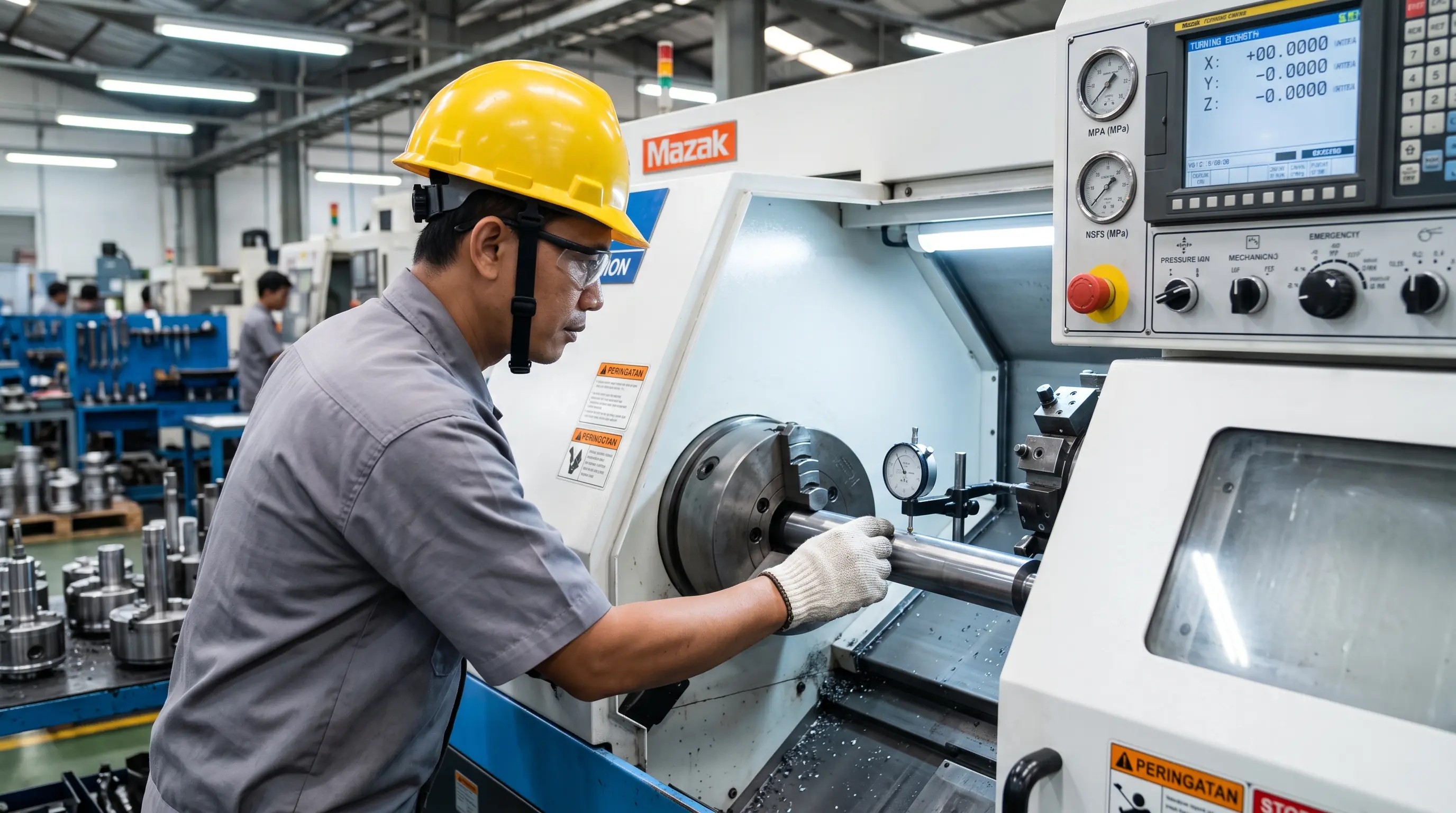
CNC turning, fundamentally executed on a lathe, operates on a kinematic principle that is the inverse of milling. In this process, the workpiece is clamped in a rotating chuck or collet and spun at high speed, while a stationary single-point cutting tool is fed into the material to remove layers along its circumference. This process is the gold standard for producing rotationally symmetric components, including shafts, rods, bushings, and fasteners.
Lathe Architecture and Components
The architecture of a CNC turning centre is designed to support high-speed rotation and resist the continuous cutting forces inherent in turning. The headstock houses the main spindle and its drive motor, providing the necessary torque and stability for the rotating workpiece. Lathe spindles typically operate at medium speeds with high torque, generally between 3,000 and 6,000 RPM, enabling them to handle the heavy material-removal rates required for large-diameter bar stock.
Workholding is critical in turning. Three-jaw chucks are most common, providing self-centring capabilities for round parts, while four-jaw chucks allow independent adjustment of each jaw to hold irregular or off-centre workpieces. For smaller, high-precision parts, collet chucks offer superior gripping and reduced runout. To support long, slender workpieces that might otherwise deflect under cutting pressure, a tailstock provides secondary support at the free end of the material.
The Precision Advantage of Continuous Cutting
One of the primary advantages of turning cylindrical parts is the cut quality. Turning involves continuous contact between the tool and the workpiece, leading to steady-state cutting conditions that minimise vibrations and produce exceptionally smooth surface finishes. Modern CNC lathes can achieve surface finishes as fine as 0.8 μm Ra and maintain diameter tolerances within ±0.005mm. This level of precision is difficult to replicate in milling, where intermittent tool engagement creates a scalloped effect that often necessitates secondary finishing operations.
Diverse Turning Operations
While turning is primarily associated with reducing part diameter, the process encompasses several critical operations:
- Facing: The tool moves perpendicular to the rotation axis to create flat end surfaces
- Boring: Enlarges or refines the interior of pre-drilled or cast holes, ensuring high accuracy and concentricity
- Threading: Synchronises feed rate with spindle speed to cut precise internal or external threads
- Grooving and Parting: Uses narrow tools to cut channels into the workpiece or sever finished parts from raw bar stock
- Knurling: A non-cutting process that uses specialised tools to press textured patterns into surfaces for improved grip
Key Differences Between CNC Milling and Turning
The decision between milling and turning is rarely arbitrary. It is a calculated choice based on the intersection of geometry, volume, and material properties. While some parts clearly fall into one category (a square housing is a milling job, and a transmission shaft is a turning job), many components require a nuanced evaluation of both methods.
Comparative Technical Analysis
| Parameter |
CNC Milling |
CNC Turning |
| Primary Motion |
Rotating tool, moving workpiece |
Rotating workpiece, moving tool |
| Typical Geometry |
Prismatic, complex, non-symmetric |
Cylindrical, rotationally symmetric |
| Common Axis Count |
3, 4, or 5 axes |
2 or 3 axes (X, Z, and sometimes Y) |
| Material Form |
Blocks, plates, castings, forgings |
Round, hexagonal, or square bar stock |
| Tootling Type |
Multi-point (end mills, drills) |
Single-point (inserts) |
| Surface Finish (Ra) |
Higher variation often requires finishing |
Lower variation, often finished as-is |
| Standard Tolerance |
±0.013mm to ±0.025mm |
±0.005mm to ±0.013mm |
| Production Speed |
Slower for round features |
Faster for round features |
When Geometry Dictates the Process
The fundamental rule is simple: if your part is primarily cylindrical or has rotational symmetry, turning is typically the most efficient process. If your part has complex features on multiple sides, internal pockets, or non-symmetric shapes, milling is the better choice.
For example, Southside Engineering uses CNC turning to produce components such as shafts, pins, bushings, and spacers for mining equipment and agricultural machinery. The same facility uses CNC milling to produce brackets, housings, mounting plates, and complex components that require features on multiple faces.
Still unsure? Schedule a consultation with our CNC specialists to determine the optimal manufacturing approach.
Multi-Axis Milling Capabilities
The standard configuration of a CNC mill involves three linear axes: X, Y, and Z. The X-axis typically represents horizontal worktable movement, the Y-axis transverse movement, and the Z-axis vertical spindle movement. However, modern manufacturing increasingly demands 4-axis and 5-axis capabilities.
Three-Axis Milling
Three-axis milling is suitable for relatively simple components, such as brackets or housing plates. While versatile, it often requires multiple setups to machine different sides of parts, introducing potential alignment errors with each repositioning.
Four-Axis Milling
A 4-axis mill incorporates an additional rotary axis (the A-axis), allowing the workpiece to rotate. This facilitates machining of undercuts and angled features without multiple setups, essential for machining features on the periphery of a part without manual repositioning.
Five-Axis Milling
The 5-axis milling machine represents the pinnacle of prismatic machining. By adding two rotational axes, the machine can orient the tool or workpiece to virtually any angle. This enables machining of all five sides of a part in a single setup, significantly reducing cumulative error from multiple clamping operations. Such configurations are indispensable for manufacturing components with complex organic shapes, such as turbine blades and medical implants.
Southside Engineering's multi-axis CNC capabilities enable customers to design parts for function rather than being constrained by manufacturing limitations. If the geometry can be modelled in CAD, it can be machined with precision.
Cutting Tools and Material Selection
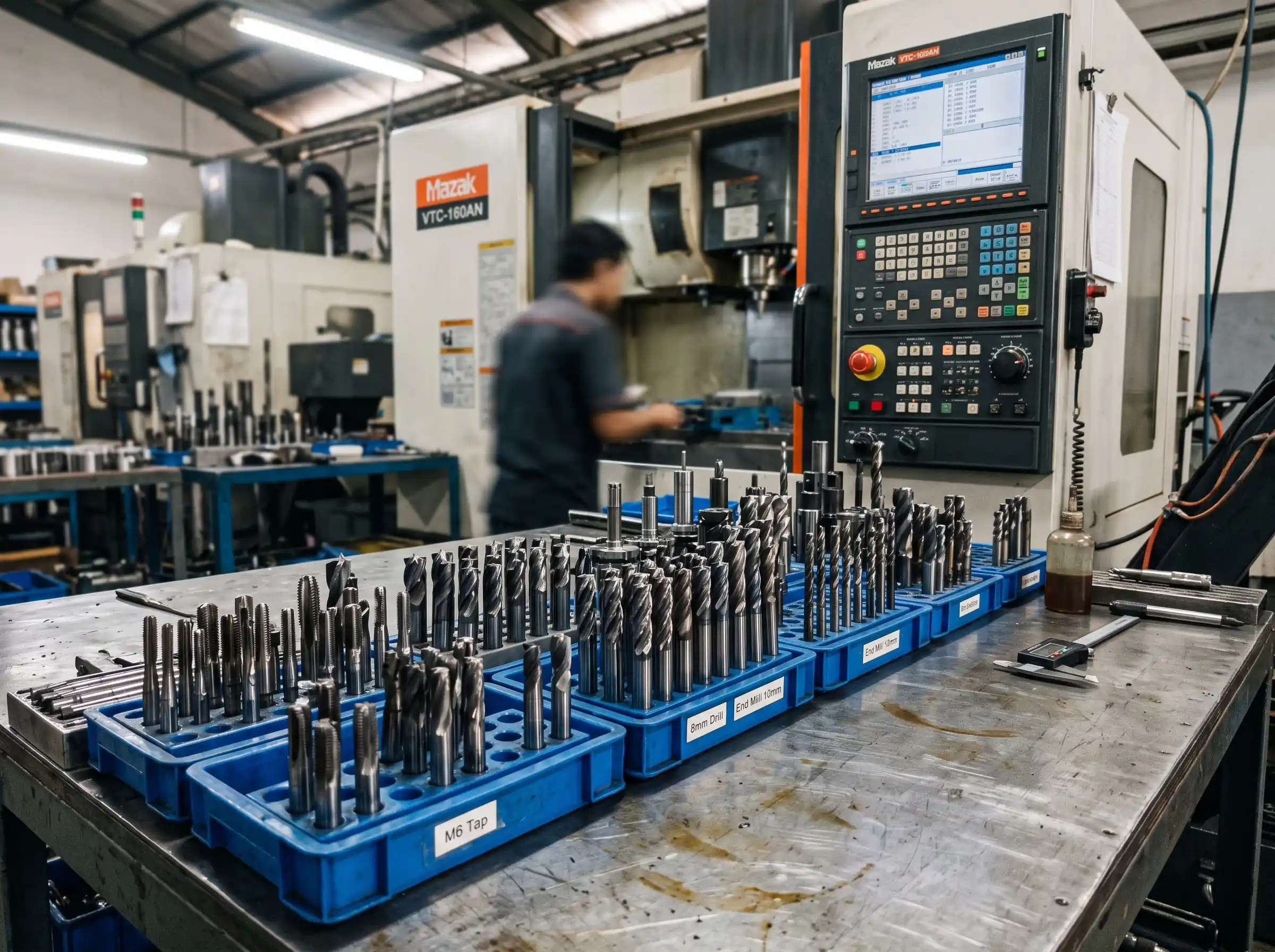
The physical limit of any CNC process is the cutting tool's performance at the point of engagement. Tooling must possess three critical properties: hardness (wear resistance), toughness (breakage resistance), and hot hardness (the ability to maintain these properties at elevated temperatures).
Tool Material Classification
| Material |
Relative Hardness |
Max Operating Temp |
Ideal Applications |
| High-Speed Steel (HSS) |
Low (~62 HRC) |
600°C |
Manual machines, prototyping, soft materials |
| Cemented Carbide |
High (~1,500 HV) |
900°C |
General CNC production, steels, cast iron |
| Ceramics |
Very High |
1,200°C |
High-speed finishing of super-alloys and cast iron |
| CBN (Cubic Boron Nitride) |
Extremely High |
1,000°C |
Hardened steels (>45 HRC), abrasive alloys |
| PCD (Polycrystalline Diamond) |
Highest (>10,000 HV) |
800°C |
Aluminium, carbon fibre, non-ferrous, composites |
Chemical and Mechanical Tool Interactions
The choice of tool material is often dictated by chemical compatibility between the tool and workpiece. For instance, PCD is the hardest known cutting material, making it ideal for abrasive high-silicon-aluminium or carbon-fibre composites. However, PCD cannot be used to machine ferrous metals like steel or cast iron because the carbon in the diamond reacts with iron at high temperatures to form iron carbide, which causes the tool to chemically dissolve.
For high-heat ferrous applications, ceramic tools are often employed. Ceramics such as aluminium oxide or silicon nitride retain hardness even at extremely high temperatures, allowing them to operate at cutting speeds far exceeding those of carbide. However, their inherent brittleness makes them unsuitable for interrupted cuts (such as those in milling) unless the setup is extremely rigid.
When to Choose Milling vs Turning
Choose CNC Milling When:
- Parts have prismatic or box-like shapes
- Components require features on multiple faces or sides
- Internal pockets, slots, or complex cavities are needed
- Non-symmetric geometries are required
- Flat surfaces and perpendicular features dominate the design
- Working from plate, block, or forging stock
Choose CNC Turning When:
- Parts are cylindrical or have rotational symmetry
- High-quality surface finishes are required on round surfaces
- Production volumes are high, and parts are similar
- Working from round bar stock
- Tight diameter tolerances are critical
- Components include shafts, pins, bushings, or threaded fasteners
Consider Both When:
- Parts combine cylindrical bodies with complex features
- Components require both excellent surface finish and complex geometries
- Production volumes justify the investment in mill-turn technology
| Standard/Tool |
Focus Area |
Application in CNC Engineering |
| ISO 9001:2015 |
Quality Management |
Foundation for process consistency and customer satisfaction. |
| AS9100D |
Aerospace & Defence |
Strict traceability and risk management for flight-critical parts. |
| ISO 13485 |
Medical Devices |
Standards for biocompatibility and sterile manufacturing. |
| AS/NZS 5131 |
Structural Steel |
Governing tolerances for fabricated structural components. |
| CMM Systems |
Metrology |
Automated inspection with 2-micron repeatability. |
CNC Milling and Turning in Melbourne
Melbourne's South East manufacturing corridor is home to some of Australia's most advanced CNC milling and turning facilities. Southside Engineering, based in Mordialloc since 1973, operates both multi-axis milling centres and precision turning centres within one facility, enabling seamless process selection and execution.
Local Advantages
When searching for "CNC machining near me" or precision engineering Melbourne services, local manufacturers offer distinct benefits:
Same-Day Consultations: Meet face-to-face with engineers who will machine your parts. Review CAD models together and discuss Design for Manufacturability optimisations on the spot.
Rapid Prototyping: 24-48 hour turnaround for simple to moderate complexity parts. No 12-week overseas shipping delays or customs clearance bottlenecks.
First Article Inspection: Inspect parts in person during FAI. Make real-time decisions about tolerances, finishes, and functional testing.
Iterative Design Collaboration: Weekly design changes are normal in product development. Local CNC milling Melbourne and CNC turning Melbourne facilities accommodate iteration at minimal cost compared to offshore manufacturers, who charge setup fees for every revision.
Industry-Specific Expertise: Melbourne manufacturers serve demanding sectors including defence, mining, medical equipment, rail, and heavy trucks — industries where precision and traceability are non-negotiable.
Interested in mill-turn efficiency? Get a quote for your next complex component.
| DFM Factor |
Recommendation |
Consequence of Non-Compliance |
| Internal Corners |
Use radii matching standard tool diameters |
Sharp corners cannot be machined; requires EDM |
| Pocket Depth |
Keep depth ≤ 4x width |
Tool deflection, poor finish, increased breakage risk |
| Wall Thickness |
Minimum 0.5mm for metals; 1.0mm for plastics |
Part warping, vibration, and failure during machining |
| Hole Depth |
Avoid holes deeper than 6x diameter |
Requires specialised drills; increased cost and risk |
| Tolerances |
Apply tight margins only to critical surfaces |
Exponentially higher costs due to slower speeds and inspection |
Troubleshooting Common Manufacturing Challenges
Challenge 1: Poor Surface Finish in Milling
Problem: Milled surfaces show excessive tool marks, chatter marks, or inconsistent finish quality.
Solution: Check for proper tool engagement. Use climb milling for better surface finish where possible. Verify that spindle speeds and feed rates are appropriate for the material. Ensure machine rigidity and proper workholding to eliminate vibration. Consider using finishing passes with minimal material removal to reduce cutting forces. For critical surfaces, specify surface finish requirements (Ra values) on drawings.
Challenge 2: Dimensional Inaccuracy in Turning
Problem: Turned diameters are out of tolerance or vary across production runs.
Solution: Check for tool wear and replace inserts regularly. Verify that the workpiece is securely held in the chuck and that the clamping force is sufficient. For long, slender parts, use a tailstock support to prevent deflection. Monitor for thermal drift during long production runs. Ensure coolant is properly directed at the cutting zone to manage heat. Implement in-process inspection to catch issues early.
Challenge 3: Tool Breakage
Problem: Cutting tools break prematurely during machining operations.
Solution: Verify that programmed speeds and feeds are appropriate for the tool material and workpiece. Check for proper tool engagement (an overly aggressive entry can shock-load tools). Ensure adequate coolant flow to manage heat and chip evacuation. For deep pockets or holes, use peck drilling or helical interpolation to manage chip evacuation. Consider using more robust tool materials (carbide instead of HSS) for harder materials.
Challenge 4: Choosing Between Processes
Problem: Uncertainty about whether to specify milling or turning for components with both cylindrical and complex features.
Solution: Consult with your CNC manufacturing partner early in the design phase. Southside Engineering provides Design for Manufacturability (DFM) support to help optimise part geometry and process selection. For parts that require both processes, consider mill-turn capabilities, or accept that parts may require operations on both machine types. Design parts to minimise the number of setups required across both processes.
Conclusion: Mastering Both Processes for Manufacturing Excellence
CNC milling and turning are not merely methods of shaping metal. They are the fundamental mechanisms through which engineers' digital ideas are realised as physical components. Milling offers the geometric freedom to create complex, prismatic parts that form the structural core of modern technology, while turning provides the rotational efficiency and precision required for the moving components of our world.
Why Southside Engineering for CNC Milling and Turning
Since 1973, Southside Engineering has maintained comprehensive capabilities in both CNC milling and turning processes. Based in Mordialloc at the heart of Melbourne's manufacturing corridor, the facility offers state-of-the-art equipment for both processes, including multi-axis milling centres (3, 4, and 5-axis configurations), precision CNC turning centres with live tooling, Swiss-style turning for micro-components, and comprehensive tooling expertise across all material types.
Southside Engineering's ±0.01mm precision capability serves the most demanding applications in defence, medical, mining, and transport sectors. The facility provides complete process selection support, helping customers choose the optimal manufacturing method for their components based on geometry, material, volume, and tolerance requirements.
Get Expert Guidance on Your CNC Manufacturing Project
Whether your components require CNC milling, turning, or both processes, Southside Engineering provides the expertise and equipment to deliver precision-engineered parts on time and to specification. Contact Southside Engineering today. Submit your CAD files or technical drawings for detailed quotes and process recommendations. Speak directly with experienced engineers about the best manufacturing approach for your specific components.