Introduction
Australia’s medical technology sector is growing. Investment in advanced manufacturing of medical devices is rising. And Australian manufacturers and device OEMs are increasingly looking for CNC machining services that understand what medical work actually requires, not just a shop with a milling machine and a price list.
This guide covers the three things that matter most when sourcing CNC machined components for medical equipment: materials, precision, and traceability. It draws on Australian regulatory frameworks, including the Therapeutic Goods Administration (TGA), and the international standards that govern medical-grade machining work.
Summary
Key Takeaways
- Material selection is the foundation. For surgical instruments and device componentry, 316L stainless steel and titanium alloys (Ti-6Al-4V ELI) dominate. Implant-grade work adds a separate layer of material standards under ASTM F136, ASTM F138 and the ISO 5832 series.
- Medical component tolerances are tight, but not uniform. Critical features in precision CNC machining for medical applications often run in the ±0.005–0.02mm range. Tolerances should be called out only where the function demands them. Blanket over-specification raises cost without improving performance.
- Surface finish matters for cleanability and biocompatibility. Equipment-grade components typically target Ra 0.4–0.8µm, smooth enough to clean reliably, without the sub-0.025µm requirements that apply to implant articulating surfaces.
- Traceability is non-negotiable. Medical OEMs need complete material genealogy: from the mill certificate on the raw stock through to the finished machined lot, with inspection records linked to each batch. ISO 13485:2016 is the quality management standard that underpins this system.
- ISO 13485 is a market expectation, not a direct TGA mandate for machining suppliers. The TGA requires this certification from device manufacturers (OEMs), not from every machinist in the supply chain, but most medical OEMs pass this requirement down through their supplier agreements.
- Local machining gives traceability advantages. CNC machining in Australia means same-day communication, no import delays, no IP exposure, and audit-ready documentation produced in English under Australian quality systems.
1. What Makes Medical Equipment Machining Different
Most CNC machining jobs are judged on three things: does it fit, does it work, and does it arrive on time. Medical equipment machining adds several more layers on top of those basics.
Higher Consequences for Errors
A bracket that is 0.3mm off-tolerance in an industrial application is an inconvenience. In a surgical instrument or a patient-monitoring device, the same error can affect function, create a safety issue, or trigger a regulatory non-conformance. Medical CNC manufacturing demands a higher base level of process control.
More Complex Documentation
For standard commercial work, a delivery docket and an invoice are enough. For medical equipment components, an OEM typically expects:
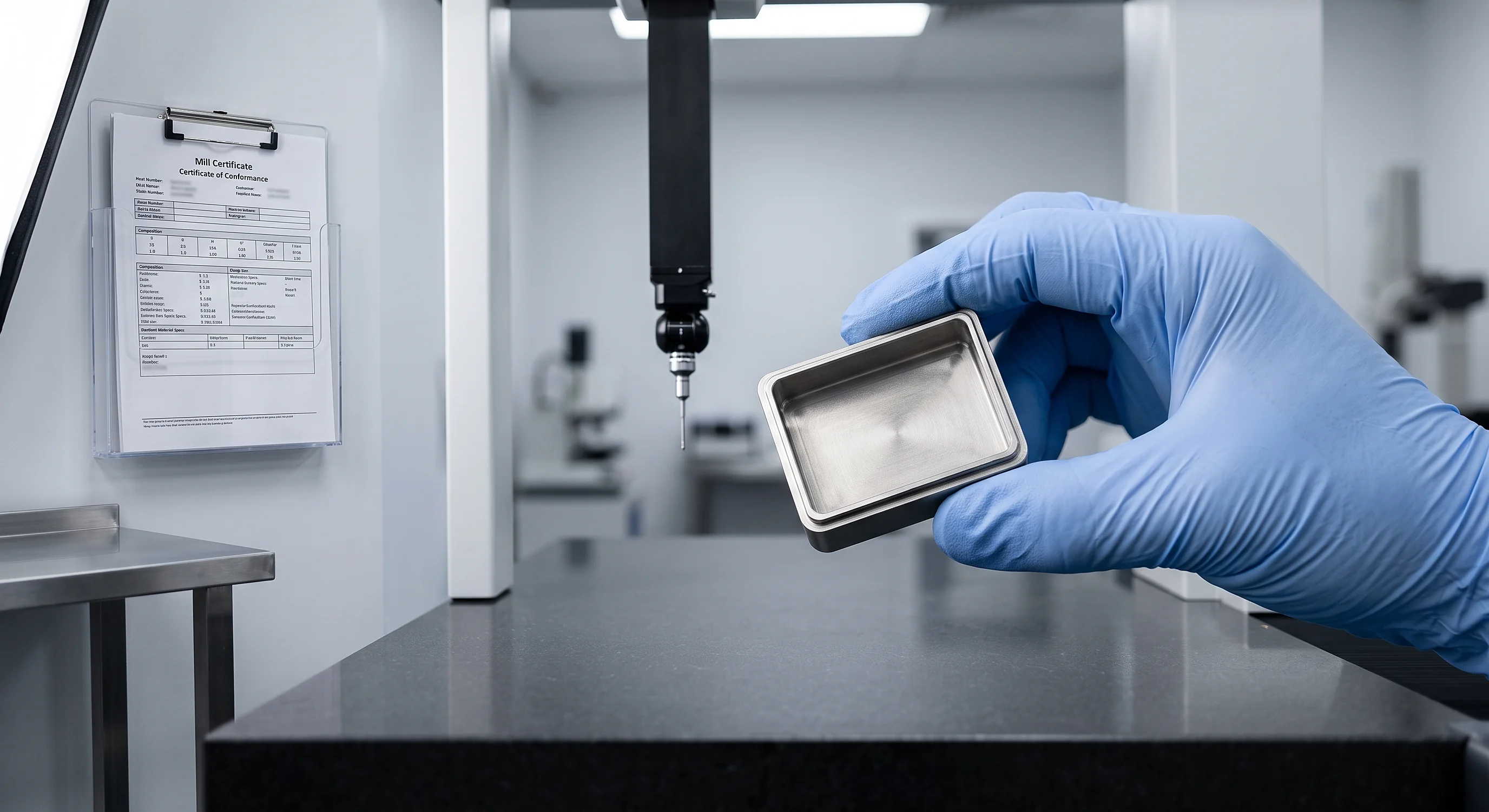
- A material certificate (mill cert) tracing the metal stock to a specific heat number and confirming chemical composition and mechanical properties
- A Certificate of Conformance (CoC) from the machining supplier
- In-process and final inspection records
- First Article Inspection reports for new part numbers
- Records retained and retrievable for the life of the device
This documentation burden is not optional: it is what allows the OEM to meet its own obligations to the TGA and to its customers.
Biocompatibility Requirements
Every material that contacts the body, or that is cleaned and sterilised repeatedly, needs to be chosen for its bio-compatibility, corrosion resistance, and stability through sterilisation cycles. A material that performs well in an industrial setting may be unsuitable for medical use if it cannot survive autoclave cycles, cannot be reliably cleaned, or releases trace elements under physiological conditions.
2. Materials: Getting the Specification Right
Material selection for medical equipment CNC machining is more constrained than for general industrial work. There are named standards for the specific grades of metal required, and those standards exist for good reasons: chemical purity, mechanical performance, and documented biocompatibility.
Metal: The Three Dominant Families
316L / 316LVM Stainless Steel
The most widely used metal in surgical instruments, device housings, brackets, and equipment componentry. 316L is a low-carbon austenitic stainless steel (≤0.03% carbon) chosen for its corrosion resistance and machinability. 316LVM is the vacuum-melted variant used in implant-grade applications: the vacuum melting process produces an ultra-low inclusion content that improves fatigue performance under long-term load.
- Governing standard for surgical implant grade: ASTM F138 / ISO 5832-1
- Most common finish for equipment-grade work: Ra 0.4–0.8µm, passivated
- Sterilisation compatibility: autoclave, EtO, gamma irradiation
Titanium Ti-6Al-4V ELI (Grade 23)
Titanium alloy is chosen for applications that need high strength at low weight, excellent corrosion resistance, and long-term biocompatibility. The ELI (Extra Low Interstitial) grade has tighter limits on oxygen, nitrogen, carbon, and iron than standard Grade 5, improving fracture toughness and fatigue life for load-bearing and long-term applications.
- Governing standards: ASTM F136 / ISO 5832-3
- Harder to machine than 316L: requires slower cutting speeds, sharp carbide tooling, and thorough coolant application
- Often specified for surgical instrument handles, implantable device frames, and structural medical componentry
Cobalt-Chrome (CoCr)
Used in high-wear, load-bearing applications, particularly the articulating surfaces of joint replacement implants (hips, knees, shoulders). Governed by ISO 5832-4 (cast alloy) and ISO 5832-12 (wrought CoCrMo). Less common in general equipment componentry because of the machinability challenges and cost, but relevant to any machining supplier working in orthopaedic implant supply chains.
Engineering Plastics for Medical Applications
Several high-performance plastics appear regularly in medical equipment CNC machining. Unlike the metals, they do not have a single named ASTM machining-material grade standard. Instead, they are qualified for medical use primarily through biocompatibility testing under ISO 10993 (biological evaluation) and often USP Class VI testing.
- PEEK (Polyetheretherketone): autoclave-stable to ~250°C; used in surgical instrument handles, guides, and implant structures where radiolucency is required
- UHMWPE (Ultra-High Molecular Weight Polyethylene): self-lubricating and abrasion-resistant; used in bearing-surface implants (hip/knee liners) and high-wear equipment components
- Delrin/acetal (medical grade): dimensionally stable, machinable, sterilisable to ~121°C; suited to instrument housings and non-implant mechanism parts
- PTFE (Teflon): chemically inert and very low friction; mainly used for seals, tubing, and non-structural device assembly components
The Implant-to-Equipment Distinction
There is an important difference between CNC machining for implantable devices and CNC machining for medical equipment and surgical instruments. Implantable components (joint replacements, spinal devices, dental implants) face the most intensive material standards, traceability requirements, and regulatory scrutiny. Equipment-grade work (housings, instrument bodies, device frames, brackets) carries a lighter documentation burden while still requiring appropriate material selection and basic traceability. Understanding where your component sits on this spectrum is the first step in specifying it correctly.
3. Tolerances, Surface Finish and Process Capability
Medical CNC machining does not require the same tolerance on every feature. Applying extremely tight tolerances everywhere on a medical component raises cost without improving function. The right approach is to identify which features are functionally critical and specify precisely what each one actually needs.
What Tight Tolerances Cost
Industry sources consistently cite ±0.005–0.02mm as the achievable tight-tolerance range for precision CNC machining of critical medical features. This is a practical capability range across the CNC machining industry, not a mandated regulatory requirement, but it gives a useful reference for what a precision machinist should be able to hold on critical bores, seating surfaces, and fit features.
As a guide, the tighter the tolerance, the more the process costs:
- Standard commercial tolerance (±0.10mm): baseline; suits the majority of non-critical features
- ±0.025mm: requires finish passes and careful toolpath management; approximately 1.5–2.0× the cost of standard work
- ±0.005–0.010mm: ultra-precision; requires temperature-controlled environments, laser tool setting, and coordinate measuring machine (CMM) inspection; 3.0–5.0× cost multiplier
Applying tight tolerances only to features that functionally require them, and using a general tolerance class like ISO 2768-Medium for everything else, keeps cost proportionate to requirement.
Process Capability: Cpk ≥ 1.67
Process capability is a measure of how well a manufacturing process can repeatedly hit its target. In the medical sector, CNC machining suppliers on critical work are often expected to demonstrate a process-capability index (Cpk) of ≥ 1.67 for key features. This is an industry practice benchmark, not a mandated standard, but it represents a level of process control that gives OEMs confidence their components will be consistently within specification across an entire batch, not just on the first article.
Surface Finish Requirements
Surface finish is specified as Ra (roughness average) in micrometres (µm). Different medical applications have different requirements:
- Equipment componentry and surgical instruments: Ra 0.4–0.8µm, smooth enough for reliable cleaning and sterilisation, without the cost of hyper-polished surfaces
- Fluid-contact surfaces and body-contact equipment: Ra 0.2–0.4µm, minimising bacterial adhesion and facilitating thorough cleaning
- Implant articulating surfaces (hip/knee/shoulder): sub-0.025µm, driven by bio-tribological requirements and wear-debris minimisation; not relevant to equipment-grade machining
For most medical equipment and surgical instrument machining, the Ra 0.4–0.8µm range is the appropriate target. Passivation of stainless steel components is standard practice: it removes free iron from the surface, improving corrosion resistance and cleaning performance. For more on how secondary finishing steps like passivation and threading affect a component’s final dimensions, see our guide to secondary operations in CNC machining.
4. Traceability: What Medical OEMs Expect
Traceability is the ability to reconstruct the full history of a component: what material it was made from, which batch of stock, which machining run, what inspection results were recorded, and where it shipped. For medical equipment OEMs, this chain of evidence is what allows them to manage their TGA obligations and, in the event of a product issue, to identify and contain the problem quickly.
The Document Chain
A full traceability system for medical CNC machined components links:
- Mill certificate → confirming the raw material heat number, chemical composition, mechanical properties, and standard compliance (e.g. ASTM F138 for 316L, ASTM F136 for titanium)
- Certificate of Conformance (CoC) → issued by the machining supplier, confirming the finished component meets the drawing specification
- In-process inspection records → dimensional checks taken during machining, not just at the end
- Final inspection report → CMM or manual dimensional report confirming critical feature compliance
- Device History Record (DHR) → maintained by the OEM, linking raw material batch to machined lot to shipment and final device
This chain has to remain intact across the lifetime of the device. ISO 13485:2016 requires records to be retained for a minimum period at least equivalent to the lifetime of the device, and not less than two years from the date of release. Many Australian OEMs apply international best practice, such as the EU MDR standard of 10 years, or 15 years for implantable devices, as their default record-retention policy.
ISO 13485:2016: The Quality System Behind Traceability
ISO 13485:2016 is the international quality management system standard specific to medical devices. For a contract CNC machining supplier working in the medical sector, holding ISO 13485 certification signals that the shop has:
- A documented QMS designed for medical-device supply chain requirements
- Full heat-number traceability from raw stock to finished component
- IQ/OQ/PQ process validation evidence (Installation, Operational, and Performance Qualification)
- Formal First Article Inspection (FAI) processes for new part numbers
- Controlled non-conformance reporting and corrective action systems
CNC machining suppliers are not directly required by the TGA to hold ISO 13485; the TGA’s certification obligations fall on the device manufacturer (the OEM or sponsor of record). But most medical OEMs pass this requirement through their supply chain agreements. For a serious precision machining supplier seeking work in the Australian medical sector, ISO 13485 is the de facto market entry requirement.
5. The TGA Framework: What Australian Manufacturers Need to Know
Australia’s medical device regulatory framework is administered by the Therapeutic Goods Administration (TGA), operating under the Therapeutic Goods Act 1989 and the Therapeutic Goods (Medical Devices) Regulations 2002. Understanding how it works helps medical OEMs, and their CNC machining suppliers, understand what is required at each level of the supply chain.
The ARTG and Essential Principles
Medical devices must be entered on the Australian Register of Therapeutic Goods (ARTG) before they can be legally supplied in Australia. The Regulations set out 15 Essential Principles, covering design safety, performance, infection control, and clinical evidence, that devices must meet. These are the OEM’s responsibility. A CNC machining supplier contributes to compliance through quality raw materials, precise manufacturing, and complete documentation, but the OEM carries the regulatory obligation.
Device Classification and What It Means for Machining
The TGA classifies medical devices by risk, from Class I (lowest risk, e.g. bandages) through Class IIa and IIb to Class III (highest risk, e.g. joint replacements, cardiac devices, active implantable devices). Higher-risk devices face stricter conformity assessment and more intensive quality system requirements.
For CNC machining suppliers, the most relevant implications by class are:
- Class I and IIa device components (surgical instruments, diagnostic equipment housings, general medical equipment): ISO 13485 is the expected QMS; full material traceability to mill certificate is standard practice
- Class IIb and III components (long-term implants, joint replacements, active implantable devices): ISO 13485 certification becomes functionally unavoidable for OEMs; machining suppliers working in this tier face the most intensive documentation expectations and may be subject to audit as part of an OEM’s conformity assessment
UDI: Australia’s Unique Device Identification System
Australia introduced Unique Device Identification (UDI) requirements through the Therapeutic Goods Legislation Amendment (Australian Unique Device Identification Database and Other Measures) Regulations 2025. Key dates include:
- 1 July 2026: Class III devices and all Class IIb devices, both implantable and non-implantable: UDI label and AusUDID submission required
- 1 July 2027: Class IIa devices
- 1 July 2028: Class I devices and IVDs
For contract CNC machining suppliers, UDI compliance is an OEM responsibility, but machined components that are the final device (rather than sub-components of a larger device) may need to accommodate UDI marking. This is a factor to discuss at drawing review stage for any component entering the ARTG as a standalone device.
6. 5-Axis CNC Machining and Complex Medical Components
Medical equipment often involves complex geometry. Surgical instrument bodies, optical housings, prosthetic structures, and diagnostic device frames are rarely flat or prismatic. They have curved surfaces, recessed pockets, internal features, and compound angles that make standard 3-axis machining inefficient, or impossible without multiple re-setups.
Why 5-Axis Matters for Medical Parts
5-axis CNC machining controls tool motion across three linear axes and two rotational axes simultaneously. For medical components, the practical benefits are:
- Fewer setups: a complex part completed in one setup accumulates no positioning error between fixturings; every feature is machined relative to the same datum
- Better dimensional consistency: reduced re-fixturing means tighter geometric relationships between features on different faces of the component
- Improved surface finish: the cutting tool can maintain optimal contact angle against curved surfaces throughout the toolpath, producing more consistent Ra values
- Shorter lead times: consolidating a job into a single 5-axis setup removes the queueing, re-fixturing, and re-measurement time that multiple 3-axis setups add. The exact time saving varies by part, but shops report meaningfully shorter cycle times on complex medical geometry compared with an equivalent multi-setup 3-axis job
For medical equipment componentry, where dimensional accuracy, surface consistency, and lead time all matter, the case for 5-axis machining is not just about capability. It is often a quality argument. Fewer touches on the workpiece means fewer opportunities for error.
Cleanroom Requirements for Medical Machining
Cleanroom environments (classified under ISO 14644) are most relevant to medical device assembly, packaging, and final cleaning, not necessarily to the CNC machining stage itself. ISO Class 7 and Class 8 environments are the most commonly cited in medical device manufacturing contexts. Many precision machined components move from a standard machine shop environment to cleanroom conditions only for final cleaning, assembly, and packaging.
If you are sourcing CNC machined components for a device that requires cleanroom handling, confirm with your machining supplier exactly which steps require a controlled environment, and whether those steps happen at the machining supplier or at your own facility downstream.
Southside Engineering: Precision CNC Machining for Medical Equipment
Southside Engineering is a 100% Australian owned CNC machining service based in Mordialloc, Melbourne. Since 1973 we have supplied precision CNC machined components to Australian manufacturers across the medical equipment, defence, mining, marine, agricultural, and general manufacturing sectors.
What we offer for medical equipment CNC machining:
- CNC milling and CNC turning to ±0.01mm tolerances
- Full material traceability, with mill certificates and Certificates of Conformance supplied on every medical job
- First Article Inspection reports for new part numbers
- Materials including 316L stainless, titanium alloys, aluminium, and medical-grade plastics (PEEK, Delrin, PTFE)
- 24-hour prototyping for urgent design validation and first-article review
- Quote response within 4 business hours of receiving complete drawings
- Australian-based quality control at every stage, with no offshore shortcuts
Whether you need a single prototype or a production batch of medical equipment components, our Mordialloc workshop is set up to quote quickly and machine precisely. We work in metal machining and medical-grade plastics alike, and OEMs comparing a CNC machinist Melbourne team against an interstate or offshore option usually come to us for the same reason: they want to see the workshop, talk to the machinist, and get traceability documents they don’t have to chase. If you need a CNC machining Melbourne supplier with a track record in regulated industries, or a CNC mill Australia workshop that understands medical-grade documentation, our team is ready to talk through your drawings.
Call (03) 9587 0405 or request a quote at ssengineering.com.au. We welcome enquiries from medical OEMs, procurement teams, and engineers across Melbourne’s south-east.