The quality of your engineering drawings has a direct impact on how quickly and accurately a CNC machining shop can quote your job. Whether you are sending one-off prototypes or recurring production work, getting your file formats, material specs, tolerances, surface finish callouts, and geometry right before submitting saves days on every quote cycle.
Summary
Key Takeaways
- Send a STEP file and a matching 2D PDF. The 3D model gives the machinist geometry for programming; the 2D drawing is the contract carrying tolerances, thread specs, and finish callouts.
- Specify the exact material grade and temper. Aluminium 7075-T6 costs two to three times more than 6061-T6 in raw material (Ryerson, 2024). Specifying the grade avoids inflated quotes from conservative assumptions.
- Use ISO 2768-mK for general tolerances and reserve tight callouts only for functional features like press-fit bores and sealing surfaces.
- Standard CNC machining produces Ra 1.6 to 3.2 µm surface finish (CNC Pioneer, 2025). Finer finishes add polishing or grinding steps that increase price and lead time.
- Account for anodising dimensional growth. Standard sulphuric anodising adds approximately 0.005 to 0.015 mm per side; hard anodising up to 0.025 mm per side (Anoplate, 2024).
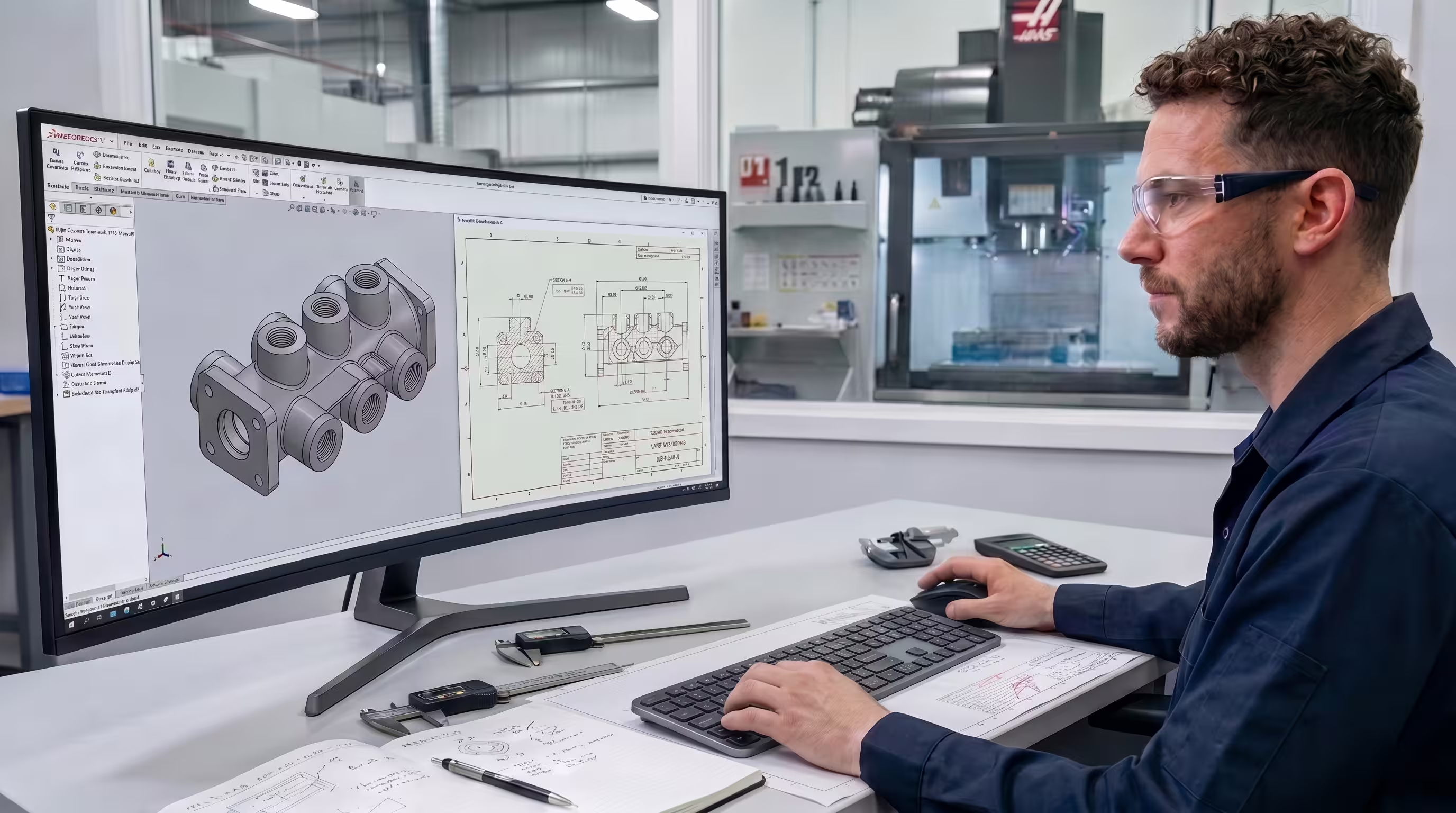
1. Send Both a 3D Model and a 2D Drawing
The fastest way to get an accurate quote is to provide two files: a 3D solid model (STEP format is the industry standard for neutral CAD exchange) and a matching 2D technical drawing as a PDF.
The 3D model gives the machinist the geometry they need for programming. The 2D drawing is the contract. It carries the tolerances, surface finish callouts, thread specs, and any notes about secondary processing like anodising or powder coating.
If your 3D model and 2D drawing do not match, the quoting process stops while the shop works out which one is correct. Always check that both files reflect the same revision before submitting.
2. Be Specific About Materials
Writing “Aluminium” or “Stainless Steel” in the material field is not enough. Different grades machine very differently, and the raw material cost can vary significantly.
Aluminium Grades
Aluminium 6061-T6 is widely stocked, machines well, and is cost-effective. Aluminium 7075-T6 offers higher strength for aerospace and defence applications but costs two to three times more in raw material (Ryerson, 2024). Specifying the exact grade and temper condition (for example, 6061-T651 Plate) allows the machinist to price materials accurately and choose the right cutting parameters from the start.
Stainless Steel Grades
Stainless 303 is a free-machining grade with a machinability rating of approximately 78%, making it well suited to CNC turning. Stainless 316, by contrast, has a machinability rating of approximately 36% and work-hardens quickly, requiring slower speeds, sharper tooling, and more rigid setups (Worthy Hardware, 2024). Specifying the correct grade avoids a back-and-forth clarification that adds days to the quote.
3. Apply Tolerances Where They Actually Matter
Tighter tolerances cost more. That is not a sales pitch; it is physics. As tolerance requirements tighten, the machining process demands slower feed rates, more finishing passes, specialised tooling, and often CMM inspection rather than a quick check with callipers.
The most cost-effective approach is to apply a general tolerance note, such as ISO 2768-mK (medium linear tolerances with K-class geometric tolerances), to cover all non-critical dimensions. Then reserve tight, explicit tolerances only for features that genuinely need them, such as press-fit bores, sealing surfaces, or alignment datums.
This makes your intent clear. The machinist knows exactly which features are critical and which have standard allowances, so they can plan their CNC milling and metal machining operations accordingly.
4. Surface Finish: Say What You Need and When
Standard CNC machining produces a surface finish between Ra 1.6 and Ra 3.2 micrometres (CNC Pioneer, 2025). That is the typical default range for most shops and is perfectly adequate for most structural and mechanical applications. Requesting a finer finish adds polishing or grinding steps that increase the price and the lead time.
If your part requires a surface coating such as anodising, plating, or powder coating, note whether your dimensions apply before or after the coating. Standard sulphuric anodising grows approximately 0.005 to 0.015 mm of dimensional change per side, because roughly half to two-thirds of the oxide layer penetrates into the substrate rather than building outward (Anoplate, 2024). Hard anodising can add up to 0.025 mm per side. A simple note like “Ø20.00 +0.01/+0.02 mm AFTER ANODISING” saves the machinist from guessing and reduces the risk of parts failing inspection after treatment.
5. Clean Up Your Geometry
CAD files accumulate clutter. Duplicate lines, unclosed profiles, stray geometry, and micro-gaps in 2D vector files can all cause problems when the machinist imports your drawing into their CAM software.
Before submitting, run a cleanup on your CAD file to remove overlapping vectors and seal any open boundaries. For internal corners, always include a fillet radius rather than specifying a sharp 90-degree corner. CNC milling cutters are round, so they physically cannot produce a sharp internal vertical corner. Designing with a radius slightly larger than the tool radius keeps machining smooth and avoids unnecessary costs.
6. How Better Drawings Lead to Better Outcomes
For buyers and project agents sending recurring work to a CNC machining partner, drawing quality compounds over time. Clean drawings mean faster quotes, fewer engineering queries, shorter lead times, and more predictable pricing.
At Southside Engineering, we work with fabrication companies, heavy equipment manufacturers, and general manufacturing teams across Melbourne who value that kind of efficiency. We are happy to review your drawings and flag anything that might slow down the quoting or machining process before it becomes a problem.
We offer CNC machining, CNC milling, CNC turning, high-volume machining, rapid prototyping, and assembly and production from our workshop in Mordialloc, Melbourne. 100% Australian owned for over 50 years.
Ready to send your next drawing package? Get a quote or call us on (03) 9587 0405.