Southside Engineering Blog

Materials Guide for CNC Milling: Aluminium, Steel, Brass, and Engineering Plastics
Introduction
Every CNC milling project starts with a material choice that affects performance, finish, and cost. Choosing well means a reliable part; choosing poorly risks failure, overspending, or unusable components.
There are dozens of metals and plastics for CNC machining, each with unique strengths, trade-offs, and costs. For most projects in our workshop, the choice typically comes down to four groups: aluminium, steel (mild and stainless), brass, and engineering plastics. These meet the needs of most Australian manufacturers, fabricators, and product developers.
This guide offers a machinist’s perspective. We focus on the grades we machine most at our Mordialloc workshop, the real-world trade-offs, and practical insights to help you choose confidently.
Summary
Key Takeaways
- Aluminium (especially 6061-T6) is the most popular CNC milling material because it machines quickly, costs less per part, and suits a wide range of structural and cosmetic applications.
- Mild steel offers raw strength at the lowest material cost, while stainless steel adds corrosion resistance for food, medical and marine environments — though it takes longer to machine and wears tooling faster.
- Brass (particularly C360) produces exceptionally clean cuts with minimal burr, making it ideal for fittings, valves and electrical connectors that demand tight tolerances and smooth sealing surfaces.
- Engineering plastics like PEEK, nylon and acetal solve problems where metal falls short — chemical resistance, electrical insulation, low friction, and significant weight savings.
- The right material choice is driven by how the part will actually be used: its operating environment, the loads it must carry, the tolerances it needs to hold, and your budget.
1. How to Think About Material Selection
Instead of jumping to alloys, first assess your part's needs. Matching material properties to application demands is key—not simply picking the strongest or cheapest option.
From our CNC machining experience in fabrication, mining, food processing, marine, and custom projects, the key factors typically fall into a few categories:
- Operating environment – will the part be exposed to moisture, chemicals, heat, UV, or abrasive conditions? A mounting bracket inside a dry control panel has very different material requirements from a valve body in a dairy processing line
- Mechanical loads – does the part need to carry structural weight, resist impact, handle vibration, or provide a bearing surface? Different applications, such as load-bearing shafts and cover plates, require distinct materials.
- Required tolerances – some materials hold tight tolerances more easily than others. Brass and aluminium are dimensionally stable and straightforward to machine to ±0.01 mm. Some plastics can move with temperature and humidity, which needs to be factored in
- Surface finish and appearance – if the part is visible or needs a specific surface roughness for sealing, the material choice affects what finishes are practical and cost-effective
- Cost and lead time – exotic materials like titanium or PEEK cost significantly more than aluminium or mild steel, both in raw material and machining time. If the application doesn’t demand those properties, there’s no reason to pay for them
- Compliance – medical, food, and aerospace applications may require specific certified material grades, which narrows the field from the start
A practical approach is to list the must-haves first, then consider nice-to-haves. By following this framework, you can quickly narrow dozens of possible materials down to two or three realistic options, saving time and reducing decision stress.
2. Aluminium: The Default Starting Point
If you’re not sure where to start, aluminium is almost always a good place to begin. For most users, it cuts quickly, delivers clean finishes, offers a strong strength-to-weight ratio, and resists corrosion—characteristics that keep costs low and parts lasting longer without extra steps.
For the machine shop, aluminium is efficient to work with. It’s soft enough that tooling lasts well, feed rates can be pushed higher, and cycle times stay short—all of which keeps your per-part cost down. It’s also lightweight (roughly a third the density of steel), which matters for anything that moves, gets carried, or needs to minimise load on a structure.
Common Grades
- 6061-T6 – this is the workhorse. It offers a good balance of strength, weldability, and corrosion resistance, making it suitable for brackets, enclosures, mounting plates, structural frames, and general-purpose components. With a yield strength around 276 MPa and excellent machinability, it’s the grade we reach for most often
- 7075-T6 – significantly stronger than 6061 (yield strength around 503 MPa) with a higher hardness, but less weldable and slightly more expensive. It’s the go-to for jigs, fixtures, aerospace-adjacent parts, and anything where maximum strength at minimum weight is the priority
- 5083 – the marine and chemical processing choice. It has the best corrosion resistance of the common aluminium alloys and handles saltwater and industrial chemicals well. Slightly lower strength than 6061 but tougher in harsh environments
- 2024 – a high-fatigue-resistance alloy often used where the part will see repeated loading cycles. Common in transport and structural applications, though it has lower corrosion resistance than the 6000-series grades
Finishing Options
Aluminium takes well to a range of secondary processes. Anodising (clear or coloured) is the most common, adding a hard oxide layer that improves both wear resistance and appearance. Powder coating provides thicker protection for outdoor or industrial parts. Bead blasting gives a uniform matte texture, and polishing can bring the surface up to a near-mirror finish for cosmetic components.
One thing worth noting: if you’re planning to anodise, the alloy grade matters. 6061 anodises cleanly and consistently. 7075 can show a slightly yellowish tint, and 2024 can be inconsistent from batch to batch. If colour-matched anodising is important, raise it early.
When Aluminium Is the Right Choice
- Lightweight structural parts where steel would be unnecessarily heavy
- Prototypes and first-run production where fast machining reduces cost
- Components exposed to moisture, mild chemicals, or outdoor weather
- Parts that will be anodised, powder-coated, or need a decorative finish
- Heat sinks and thermal management components (aluminium conducts heat well)
Need aluminium CNC milling in Melbourne? Get a quote from Southside Engineering →
3. Steel: When Strength and Hardness Come First
When a part needs to carry heavy loads, withstand impact, or withstand abrasive conditions, steel is usually the answer. It machines more slowly than aluminium – harder materials wear tooling faster and require lower feed rates – but the mechanical properties make the extra time worthwhile for structural and heavy-duty applications.
Steel comes in a wide range of grades, but for CNC machining, the practical choice usually falls between mild (carbon) steel for strength at low cost and stainless steel when corrosion resistance is essential.
Mild Steel (Carbon Steel)
Mild steel is the most affordable structural metal and the backbone of Australian fabrication. It’s strong, weldable, and readily available in a range of plate and bar sizes. The trade-off is that it has no inherent corrosion resistance, so it generally needs to be painted, powder-coated, zinc-plated, or galvanised for any environment where moisture is present.
- 1018 – a low-carbon, general-purpose steel with excellent machinability and weldability. Yield strength is around 370 MPa. Used for brackets, fixtures, mounting plates, and fabrication sub-assemblies where corrosion isn’t a primary concern
- 1045 – a medium-carbon steel with higher strength and hardness (yield ~450 MPa). Well-suited to shafts, gears, studs, and load-bearing components. It can be heat-treated for additional hardness
- 4140 – a chromium-molybdenum alloy steel with excellent toughness and fatigue resistance. Used for high-stress applications like axles, crankshafts, and structural components that will see repeated loading
Stainless Steel
Stainless steel adds chromium (at least 10.5%) to the mix, forming a passive oxide layer that protects against rust and corrosion. This makes it essential for food processing, medical devices, marine hardware, chemical handling, and any environment where parts are regularly washed, sterilised or exposed to corrosive substances.
The trade-off is machinability. Stainless steel requires more effort and time to machine, which increases costs. However, if your project must withstand regular cleaning, harsh chemicals, or moisture, the investment ensures lasting performance and peace of mind.
- 304 – the most widely used stainless grade. Good all-round corrosion resistance, excellent weldability, and suitable for kitchen equipment, architectural fittings, general industrial components, and non-contact food equipment
- 316 – the step up when you need resistance to chlorides, acids, and aggressive cleaning chemicals. The added molybdenum gives it superior performance in marine, dairy, pharmaceutical, and chemical processing environments. If in doubt between 304 and 316 for food or medical work, 316 is the safer choice
- 303 – a free-machining stainless grade optimised for high-volume CNC production. It machines significantly faster than 304 or 316 but has slightly lower corrosion resistance. Ideal for fittings, fasteners, and precision-turned parts where machining speed matters
When Steel Is the Right Choice
- Heavy structural loads, impact resistance, or high-vibration environments
- Components in fabrication assemblies that will be welded into larger structures
- Food, medical, marine, or chemical environments requiring corrosion resistance (stainless)
- Parts that will be heat-treated for additional hardness or wear resistance
- Cost-sensitive structural parts where aluminium’s higher material cost isn’t justified
4. Brass: Precision, Clean Cuts, and Corrosion Resistance
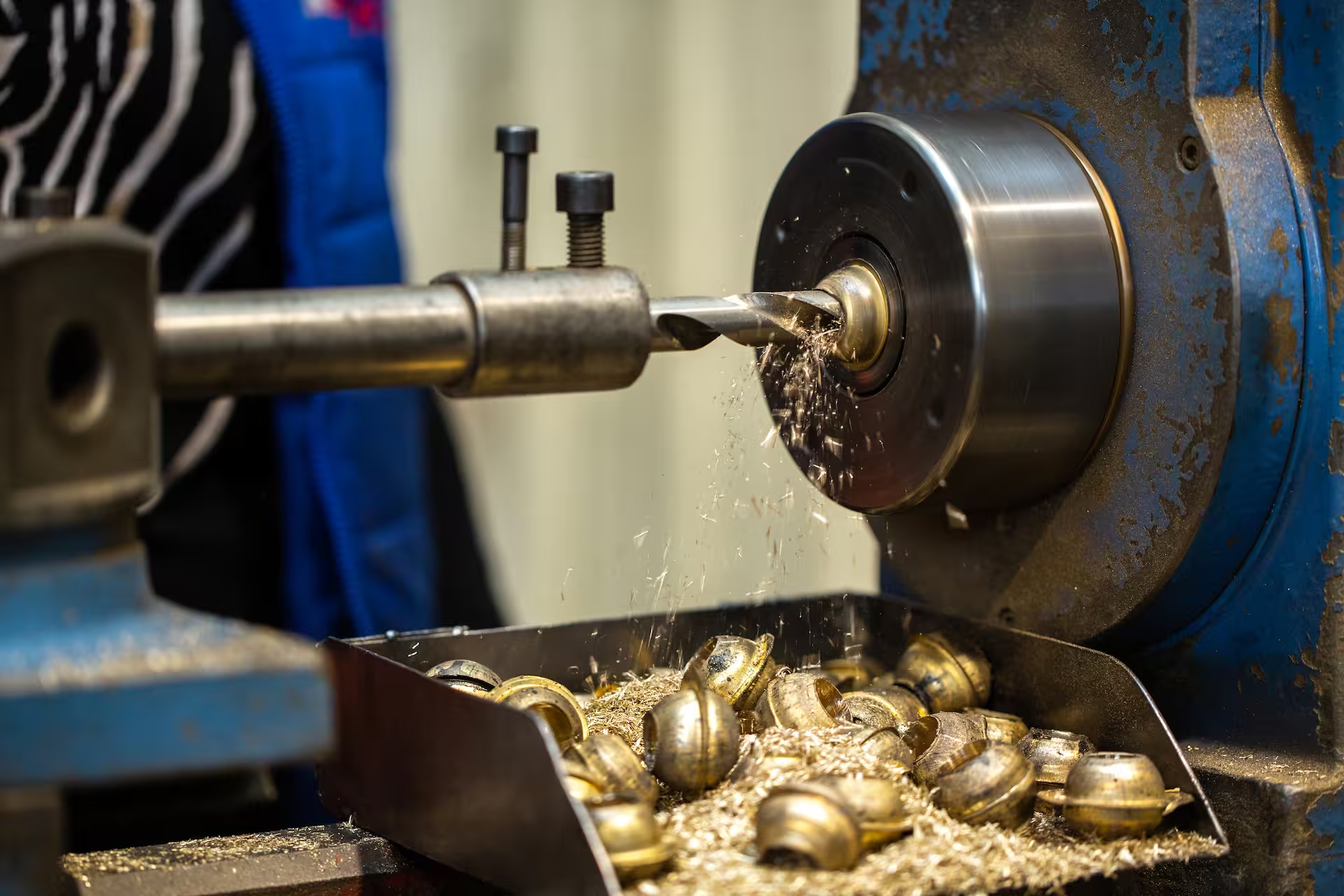
Brass, a copper-zinc alloy, occupies a unique position among CNC milling materials. It machines beautifully – producing clean, burr-free cuts with an excellent surface finish straight off the tool – which means less post-processing, tighter tolerances, and faster turnaround on precision components. It’s a material we work with regularly on our CNC turning and CNC milling machines.
It’s also naturally corrosion-resistant, non-sparking, and has useful antimicrobial properties. Its warm gold colour gives it a visual appeal that makes it popular for architectural and decorative hardware, while its electrical conductivity makes it a standard for connectors and terminals.
Common Grades
- C360 (free-cutting brass) – the most machinable brass grade and one of the most machinable metals full stop. It’s the benchmark for fittings, valves, connectors, bushings, and any turned or milled component where surface finish and dimensional accuracy are priorities. Yield strength around 275 MPa with excellent elongation
- C260 (cartridge brass) – a 70/30 copper-zinc alloy with good formability and corrosion resistance. Often used for decorative and architectural components
- C932 (bearing bronze) – technically a bronze rather than a brass, but commonly requested alongside brass work. It offers good strength and wear resistance, making it ideal for bearings, bushings, pump components, and hydraulic fittings
Why Brass Machines So Well
Brass forms short, broken chips during cutting rather than long stringy swarf, which means the machine runs cleanly with minimal chip-clearing issues. The material doesn’t work harden the way stainless does, so tooling lasts well, and consistent results come batch after batch. For high-precision turned parts — fittings, valve seats, and threaded connectors — it’s hard to beat.
When Brass Is the Right Choice
- Fittings, valves, and connectors that need smooth sealing surfaces
- Electrical terminals and connectors requiring good conductivity
- Plumbing and hydraulic components
- Decorative or visible hardware where appearance matters
- High-precision parts with tight tolerances where a burr-free finish reduces secondary operations
5. Engineering Plastics: When Metal Isn’t the Answer
There are applications where metal is simply the wrong material. When you need electrical insulation, chemical resistance, lightweight performance, low friction, or biocompatibility, engineering plastics offer properties that no metal can match. CNC-machined plastics also give you tolerances that injection moulding can’t achieve at low volumes, making them ideal for prototypes, custom components, and specialised one-off parts.
The key difference from machining metals is that plastics behave differently under the tool. Some absorb moisture and swell. Some soften with heat and require slower feed rates or air cooling. And some are dimensionally sensitive to temperature changes, which means tolerances need to be realistic for the material. A good machine shop will factor all of this in.
Common Grades
- PEEK (Polyether Ether Ketone) – the high-performance option. It handles continuous operating temperatures up to 250°C, resists most chemicals, absorbs virtually no moisture, and is biocompatible. Used for medical implant components, semiconductor equipment, aerospace parts and food processing. The trade-off is cost — PEEK bar stock is expensive, which makes it a material you choose when the application genuinely demands it
- Acetal / Delrin (POM) – one of the easiest plastics to machine, with excellent dimensional stability, low friction, and good strength. It’s the go-to for precision gears, rollers, bushings, conveyor components, and any part that needs to slide or rotate with minimal wear
- Nylon (Polyamide) – strong, tough, and self-lubricating. Common grades include Nylon 6 and Nylon 66, used for bushings, gears, bearings, wear pads, and food processing guides. It absorbs more moisture than Acetal, which can affect dimensions in humid environments
- ABS – impact-resistant and easy to machine. Widely used for enclosures, housings, prototypes, jigs, and fixtures
- UHMWPE – extremely wear-resistant and self-lubricating, with FDA approval for food contact. Used for guide rails, wear strips, and conveyor components in food processing
When Engineering Plastics Are the Right Choice
- Electrical insulation is a hard requirement
- Chemical resistance to acids, solvents, cleaning agents, or other aggressive substances
- Weight reduction where the metal is heavier than the application needs
- Low-friction or self-lubricating wear parts like bushings, guides, and rollers
- Biocompatible or food-safe components where material certification matters
- One-off or low-volume parts where injection moulding isn’t viable
Not sure whether your part needs metal or plastic? Talk to Southside Engineering — we machine both. →
6. Material Comparison at a Glance
The table below summarises the key differences across the most common CNC milling materials. Use it as a starting point, but remember that the right choice always depends on the specific application.
A few things this table doesn’t capture: lead time (exotic materials or non-stock grades take longer to source), minimum order sizes for raw material, and the impact of secondary processes like heat treatment or anodising on the final cost and timeline. These are all things we can advise on when you send through your drawings.
7. Surface Finish and Secondary Processes
The material you choose also determines what finishing options are available and practical. Surface finish matters both for function (sealing faces, bearing surfaces, and hygiene) and for appearance (customer-facing products and architectural hardware).
Here’s a quick overview of common finishes by material:
- Aluminium – anodising (clear, black, colour), powder coating, bead blasting, polishing, chromate conversion
- Mild steel – powder coating, zinc plating, electroplating, painting, hot-dip galvanising
- Stainless steel – passivation, electropolishing, mechanical polishing, bead blasting
- Brass – polishing (to a high shine), lacquering, nickel plating, left natural (develops a patina over time)
- Engineering plastics – generally used as-machined. Some can be vapour-smoothed or polished for cosmetic applications
If your part has threads, it’s also worth considering how they’ll be finished. For lightly loaded threads, a machined-in thread is fine. For threads that will see repeated use or significant stress, a Helicoil or keyed insert can significantly extend the part’s service life.
8. How to Choose: A Practical Framework
If you’re still weighing up options, here’s a simple framework that covers most situations:
Start with the environment. If the part will face moisture, chemicals, or food contact, that typically rules out mild steel and points you towards stainless, aluminium, or an appropriate plastic.
Then consider the loads. Heavy structural loads and impact favour steel. Moderate loads where weight matters point to aluminium. Light loads or sliding/rotating applications often suit plastics.
Factor in tolerances and finish. If you need very tight tolerances and a clean surface finish with minimal post-processing, aluminium and brass are the easiest to work with. Stainless is achievable but costs more in machining time.
Check for compliance requirements. Medical, food, and aerospace applications often mandate specific material grades with traceable certification. This narrows the field before you even consider properties.
Then look at the budget. If two materials both meet the functional requirements, the one that machines faster and costs less in raw material is usually the right call. There’s no engineering benefit in using 316 stainless when 6061 aluminium does the job.
And if you’re unsure, send us the drawing with a note about the application. Our CNC machinist Melbourne team will recommend a material based on what we’ve seen work in similar situations – no charge, no obligation.
Have a CNC milling project and need material advice? Get a quote from Southside Engineering →
9. Why a Local Melbourne Machine Shop Matters
Choosing the right material is only half the equation. You also need a machining manufacturer that stocks common grades, knows how each material behaves under the tool, and can advise when your drawing calls for something that’ll work better in a different alloy.
A local CNC Melbourne machine shop gives you practical advantages that offshore or interstate suppliers can’t match. Faster lead times, because the part doesn’t spend days in transit. Direct communication, because you can pick up the phone or visit the workshop. And same-day resolution when something needs to change mid-job, rather than waiting for a reply across time zones. Across the machining industry, local partnerships consistently outperform distant ones for responsiveness and quality.
Southside Engineering is based in Mordialloc, in Melbourne’s south-east manufacturing corridor. We’ve been providing CNC machining Melbourne manufacturers rely on since 1973 — over 50 years of metal machining for Australian industry. Whether you’re looking for CNC machining Australia-wide or a local partner, we serve fabricators, food manufacturers, medical device companies, mining operations and custom project clients. As a trusted machining workshop in Australia, we hold tolerances to ±0.01 mm, offer 24-hour prototyping for urgent work, and return quotes within 4 hours of receiving drawings.
10. Conclusion
Material selection shapes every aspect of a CNC manufacturing project — from how quickly the part can be machined to how it performs in service to what it ultimately costs. Aluminium offers the best all-round balance of machinability, weight and cost for most applications. Steel provides the strength and toughness needed for heavy-duty structural work. Brass delivers precision and clean finishes for fittings and connectors. And engineering plastics solve the problems where metal simply isn’t the right tool for the job.
The key is to start with the application, not the material. Understand what your part needs to do, the environment it’ll operate in, and the tolerances it needs to hold — and the right material choice will usually become clear.
Southside Engineering machines all of the materials covered in this guide from our Mordialloc workshop. Whether you need CNC machining near me for a quick prototype or a production run, send us your drawings. We’ll come back with a recommendation and a quote within 4 hours.
Ready to get started? Request a quote from Southside Engineering →

Prototype Bracket Job
The Challenge
An engineering firm needed a prototype bracket produced urgently for a major client presentation scheduled the next morning.
The project lead sent through a hand sketch mid-afternoon, with the part required by 9am the next day.
The prototype needed to be accurate, visually presentable, and functional, giving the firm’s client confidence in the concept and its manufacturability — all within a 24-hour turnaround.
Our Approach
Southside Engineering immediately prioritised the project and moved it into rapid prototype production.
Our team:
- Converted the hand-drawn sketch into a CAD model for accurate geometry and fit.
- Selected machined aluminium billet for lightweight strength and professional finish.
- Programmed CNC milling centres to achieve high accuracy and fine surface detail.
- Performed deburring and finishing to ensure the prototype looked presentation-ready.
- Coordinated morning delivery direct to the client’s office ahead of the pitch.
From concept to completion, the entire process — design, machining, finishing, and delivery — was completed overnight.
The Outcome
The bracket was delivered on time and met every design requirement.Our client used the prototype in their client pitch the following morning, demonstrating the product’s precision and manufacturability — and secured the contract.
Results:
- Prototype designed, machined, and delivered in less than 24 hours
- Machined from aluminium billet with a professional finish
- Perfect fit and functionality for client presentation
- Client secured new contract using completed prototype
Key Takeaway
When speed and precision matter, Southside Engineering’s rapid CNC prototyping services turn ideas into tangible results — fast. By combining design support, CNC milling, and overnight production, we help engineering teams and manufacturers meet deadlines with confidence.
From concept sketches to functional prototypes, Southside ensures every part is accurate, on time, and presentation-ready.
Quick Summary

Screen Printing Frame Fix
The Challenge
A local screen-printing shop owner was struggling with warped aluminium frames that caused misalignment and inconsistent print quality on every production run.
The distortion was creating wasted materials, downtime, and reprints — cutting into both profit and productivity.
The client needed a rigid, perfectly aligned frame solution that would maintain flatness and stability under printing tension.
Our Approach
Southside Engineering examined the failed frames and identified that the original hollow design lacked torsional strength.
Our team:
- Redesigned the frame using CAD modelling to increase rigidity and minimise flex during printing.
- Machined the new design from solid aluminium billet using precision CNC milling.
- Applied finishing and deburring for a smooth, tension-ready surface.
- Verified frame alignment and squareness using ±0.05mm tolerance inspection.
The complete redesign and production were completed within two business days, ensuring minimal disruption to the client’s workflow.
The Outcome
The new billet aluminium frames completely eliminated warping and alignment issues. The print shop was back in production within 48 hours, producing sharper, more consistent prints and saving time on setup adjustments.
Results:
- Redesigned and CNC-machined billet aluminium frames delivered in 2 days
- Zero frame warping or misalignment
- Improved print accuracy and repeatability
- 100% designed, machined, and inspected in Melbourne
Key Takeaway
Through smart design improvements and precision CNC machining, Southside Engineering helped a local business eliminate recurring quality issues and production waste. By combining engineering analysis, CNC milling expertise, and Australian-made precision, Southside delivers practical, long-term solutions — not just replacements.

Screen Printing Jig Rush
The Challenge
A local screen-printing company landed a large production order but realised they had no jigs or clamping fixtures ready to hold the parts for printing.
The deadline was tight — the job needed to start immediately or the company risked losing the client.
With no time to source tooling elsewhere, the owner called Southside Engineering on Friday morning looking for a complete jig solution — designed, machined, and assembled over the weekend.
Our Approach
Southside Engineering fast-tracked the project and began work the same day.
Our team:
- Designed a custom jig system based on sample components provided by the client.
- Modelled and validated the design using CAD software to ensure accuracy and repeatability.
- Machined all components from aluminium and steel stock using CNC milling and turning for precision.
- Completed assembly, testing, and finishing overnight for immediate production use.
- Delivered all four jigs to the client’s facility before Monday morning.
This project showcased the efficiency of Southside’s rapid CNC manufacturing process, combining design, machining, and assembly under one roof.
The Outcome
The client received all four jigs ahead of schedule and began production immediately.
The jigs performed flawlessly throughout the print run, allowing the business to meet its deadline and impress its new customer — resulting in a long-term contract.
Results:
- Four precision jigs designed, machined, and assembled overnight
- Seamless performance during large-scale production run
- Client met tight delivery deadline
- Long-term business secured through reliable turnaround
Key Takeaway
When speed, accuracy, and reliability matter, Southside Engineering’s CNC machining and jig manufacturing services deliver under pressure. By offering end-to-end solutions — from CAD design to assembly — all completed in-house, we help local manufacturers stay agile and competitive, even on impossible deadlines.
Quick Summary

Tolerances, Surface Finishes, and Lead Times: What to Specify When Ordering CNC Parts
Introduction
CNC machining in Melbourne serves a wide range of industries, from fabrication and heavy transport to medical devices, mining, and custom projects. Each sector has different requirements for materials, tolerances, lead times, and quality standards. This guide covers what each industry needs from a CNC machining partner and how precision manufacturing supports their work.
Summary
Key Takeaways:
- Fabricators need a reliable CNC machining partner near them for precision flanges, brackets, and fittings that integrate with their fabricated assemblies.
- Heavy truck and commercial vehicle manufacturers require high-volume CNC machining with consistent ±0.01mm tolerances for engine, transmission, and chassis components.
- Medical CNC machining demands biocompatible materials, micron-level accuracy, and smooth surface finishes for surgical instruments, implants, and diagnostic equipment.
- Mining components must be durable enough to withstand constant dust, vibration, and heavy loads. Fast turnaround for replacement parts is critical to reduce costly downtime.
- Custom CNC projects - from one-off prototypes to limited production runs - require a flexible machine shop that can work from CAD files and deliver in as little as 24 hours.
CNC Machining for Fabricators
Fabrication projects often need machined components with exact tolerances that cannot be achieved through cutting or welding alone. When a fabricated assembly requires a custom flange, machined bracket, or threaded fitting, those parts need to be right the first time. A misaligned hole pattern or an out-of-tolerance shaft can hold up an entire project.
Southside Engineering provides CNC milling and CNC turning services for fabricators in Melbourne, producing components that integrate directly into fabricated structures and assemblies. Working from your CAD files, PDF drawings, or specifications, our machine shop delivers:
- Custom flanges and mounting plates - CNC milling for exact hole patterns and flat mating surfaces
- Machined brackets and gussets - CNC-machined to exact dimensions for structural assembly
- Threaded components and fasteners - CNC turning for precise threads and consistent quality across repeat orders
- Specialty fittings and adapters - custom parts that connect fabricated equipment sections
Materials include mild steel, stainless steel, aluminium, brass, and copper. Finishing options include powder coating, anodising, and electroplating. Simple components are typically ready within 3 to 5 working days.
Need CNC machining near you for fabrication work? Get a quote from Southside Engineering.
CNC Machining for Heavy Trucks and Commercial Vehicles
Heavy truck and commercial vehicle manufacturers face two main challenges: producing large quantities of identical components consistently, and making sure those parts can handle constant vibration, heavy loads, and long operating hours without failing.
A single faulty part can cause costly downtime and safety risks across an entire fleet. This is why precision and reliability are non-negotiable in this sector.
Southside Engineering's high-volume CNC manufacturing lowers per-unit costs while keeping quality consistent across thousands of parts. We machine components to ±0.01 mm tolerances using stainless steel, aluminium, brass, copper, and engineering plastics. Key components we produce for the heavy transport sector include:
- Chassis and suspension parts - precision components that improve stability and performance
- Brackets, frames, and assemblies - custom-machined for secure, durable construction
- Fasteners, bushes, and washers - safety-critical parts built with absolute accuracy
- Spacers and mounting hardware - accurately machined for precise alignment under heavy-duty use
We also offer single-piece machined designs that eliminate the weaknesses found in multi-piece welded assemblies. For urgent repairs, prototypes can be delivered within 24 hours to get vehicles back on the road quickly.
CNC Machining for Medical Equipment
Medical CNC machining leaves no room for error. Components used in surgical instruments, diagnostic devices, and patient-specific implants must be manufactured with micron-level accuracy and smooth surface finishes, using materials that are safe for contact with the human body.
Southside Engineering machines medical components to ±0.01 mm tolerances using biocompatible materials, including titanium, stainless steel, aluminium, and engineering plastics such as PEEK, ABS, and Nylon. These materials are selected for their corrosion resistance and ability to withstand sterilisation processes such as autoclaving.
Medical components we manufacture include:
- Orthopaedic components - CNC-machined parts for surgical tools and support devices
- Medical device components - reliable parts for pumps, ventilators, and diagnostic tools
- Laboratory and equipment parts - CNC precision components for medical and lab equipment
Finishing options include polishing, bead blasting, anodising, and coating to create smooth, hygienic surfaces. Rapid prototyping is available with urgent prototypes deliverable in as little as 24 hours, supporting medical device manufacturers and research teams who need to test and validate designs quickly.
Need precision CNC machining for medical components in Melbourne? Our team can help you.
CNC Machining for Mining
Mining machinery operates in some of the harshest conditions in Australia. Constant exposure to dust, vibration, heat, and heavy loads means that components must be built to last. When a part fails on a mining site, every hour of downtime can cost thousands of dollars.
Southside Engineering produces durable CNC-machined components from stainless steel, aluminium, brass, copper, and specialty alloys designed specifically for high-impact, abrasive environments. Our precision machining achieves ±0.01 mm tolerances, ensuring reliable performance even for safety-critical parts where exact fits are essential.
Mining components we manufacture include:
- Wear-resistant components - built to endure abrasive environments and extend equipment life
- Custom fittings and housings - built for heavy machinery with reliable, long-term performance
- Safety-critical components - precision-engineered to reduce operational risk
- Repair and refurbishment parts - CNC milling and turning to restore equipment to full performance
We handle single replacement parts through to full production runs, with urgent parts deliverable within 24 hours to minimise downtime.
Custom CNC Projects
Not every project fits a standard production format. Some businesses need a one-off component that no standard supplier carries. Others need to prototype and test a new product quickly before committing to full production. Custom CNC projects cover all of these scenarios.
Southside Engineering's machine shop in Melbourne handles custom CNC machining for businesses and innovators across medical, defence, electronics, mining, automotive, and scientific research sectors. Whether you have a unique design requirement or an unusual production run, we manufacture to your exact specifications with tolerances up to ±0.01 mm.
Custom CNC services include:
- One-off components - customised parts manufactured to order from your drawings or CAD files
- Prototypes and concept models - from CAD design to physical part in as little as 24 hours
- Custom fixtures and fittings - designed for specialised applications where standard parts do not work
- Low-volume production runs - cost-efficient CNC manufacturing for niche projects that do not suit mass production
Materials include aluminium, stainless steel, brass, titanium, copper, and engineering plastics such as PEEK, nylon, and ABS, with finishing options including powder coating, electroplating, and welding.
Ready to get started? Visit ssengineering.com.au
Why a Local Melbourne Machine Shop Matters
For all five of these industries, having a CNC machining partner near you in Melbourne makes a practical difference. A local machine shop means faster lead times, direct communication, and the ability to resolve quality issues the same day rather than waiting weeks for an offshore supplier to respond.
Southside Engineering is based in Mordialloc, in the heart of Melbourne's south-east manufacturing corridor. Melbourne-based since 1973. Over 50 years of precision machining for Australian industry. We have served fabricators, transport companies, medical manufacturers, mining operations, and custom project clients. Tolerances up to ±0.01 mm, 24-hour prototyping, Australian-based quality control, and quotes within 4 hours of receiving drawings.
Conclusion
CNC machining in Melbourne supports a broad range of industries, each with different demands. Fabricators need precision components that integrate seamlessly into their assemblies. Heavy transport manufacturers need high-volume consistency and durability. Medical manufacturers need biocompatible materials and micron-level accuracy. Mining operations need rugged parts and fast turnaround. And businesses with custom projects need a flexible machine shop that can work from any drawing and deliver quickly.
Southside Engineering provides all of these services from our Mordialloc machine shop. Whether you need ongoing production or a one-off custom project, we are ready to help.
Have a custom CNC project in Melbourne? Get a quote from Southside Engineering.

Understanding CNC Milling and Turning Processes
Introduction
At the heart of modern precision manufacturing lie two fundamental CNC processes: milling and turning. While both remove material using computer-controlled precision, they work in fundamentally different ways. Understanding the distinction between these processes is crucial for selecting the right manufacturing method for your components.
This guide explains how CNC milling and turning work, when to use each process, and how Melbourne manufacturers like Southside Engineering combine both capabilities to deliver complete precision engineering solutions.
Summary
Key Takeaways:
- CNC milling uses rotating cutting tools on stationary workpieces to create complex prismatic parts
- CNC turning rotates the workpiece against stationary tools to produce cylindrical components efficiently
- Milling excels at complex geometries and non-symmetric parts, while turning delivers superior finishes on round components
- Multi-axis milling (3, 4, and 5-axis) enables increasingly complex shapes without multiple setups
- Mill-turn centres combine both processes in single machines, eliminating repositioning errors and reducing production time
Understanding CNC Milling: Rotating Tools for Complex Shapes
CNC milling is characterised by the use of rotating multi-point cutting tools that advance into a stationary or semi-stationary workpiece to remove material across multiple planes. The mechanical essence of milling lies in its versatility. Because the cutting tool can move along three, four, or five axes, the process is uniquely capable of producing prismatic parts with complex internal pockets, non-rotationally symmetric contours, and intricate 3D surfaces.
How CNC Milling Works
In a milling centre, the spindle is the primary source of cutting power. These spindles are engineered to rotate at high speeds, typically ranging from 6,000 to 24,000 RPM, though ultra-precision units can exceed 30,000 RPM for micro-machining or soft-material applications. The mechanical stability of the spindle is paramount. The intermittent nature of milling (where each cutter tooth engages and disengages from the material) creates cyclic loading that can induce vibration and chatter.
To mitigate these forces, milling machines utilise robust spindles with high-quality bearings and tapered tool holders to ensure concentricity and minimise runout. Even a minor runout of 0.01mm can significantly reduce tool life and degrade surface finish.
Common Milling Operations
The versatility of milling is expressed through various specific operations tailored to different feature requirements:
- Face Milling: Generates flat surfaces where cutting occurs at the face of the tool
- Peripheral Milling (or plain milling): Uses the sides of the cutter to produce deep slots or external profiles
- Form Milling: Produces curved surfaces matching specific contours
- Angular Milling: Creates chamfers and V-grooves
- Pocket Milling: Removes material to create recessed areas or cavities
Milling Strategy Impacts Quality
The strategy employed during operations has profound implications for final part quality. Climb milling, where the cutter rotation matches the feed direction, generally yields superior surface finish and longer tool life because the chip starts at its maximum thickness and tapers off, reducing heat at the cutting edge. However, this strategy requires highly rigid machine setups to prevent the tool from pulling the workpiece.
Understanding CNC Turning: Rotating Workpieces for Cylindrical Precision
CNC turning, fundamentally executed on a lathe, operates on a kinematic principle that is the inverse of milling. In this process, the workpiece is clamped in a rotating chuck or collet and spun at high speed, while a stationary single-point cutting tool is fed into the material to remove layers along its circumference. This process is the gold standard for producing rotationally symmetric components, including shafts, rods, bushings, and fasteners.
Lathe Architecture and Components
The architecture of a CNC turning centre is designed to support high-speed rotation and resist the continuous cutting forces inherent in turning. The headstock houses the main spindle and its drive motor, providing the necessary torque and stability for the rotating workpiece. Lathe spindles typically operate at medium speeds with high torque, generally between 3,000 and 6,000 RPM, enabling them to handle the heavy material-removal rates required for large-diameter bar stock.
Workholding is critical in turning. Three-jaw chucks are most common, providing self-centring capabilities for round parts, while four-jaw chucks allow independent adjustment of each jaw to hold irregular or off-centre workpieces. For smaller, high-precision parts, collet chucks offer superior gripping and reduced runout. To support long, slender workpieces that might otherwise deflect under cutting pressure, a tailstock provides secondary support at the free end of the material.
The Precision Advantage of Continuous Cutting
One of the primary advantages of turning cylindrical parts is the cut quality. Turning involves continuous contact between the tool and the workpiece, leading to steady-state cutting conditions that minimise vibrations and produce exceptionally smooth surface finishes. Modern CNC lathes can achieve surface finishes as fine as 0.8 μm Ra and maintain diameter tolerances within ±0.005mm. This level of precision is difficult to replicate in milling, where intermittent tool engagement creates a scalloped effect that often necessitates secondary finishing operations.
Diverse Turning Operations
While turning is primarily associated with reducing part diameter, the process encompasses several critical operations:
- Facing: The tool moves perpendicular to the rotation axis to create flat end surfaces
- Boring: Enlarges or refines the interior of pre-drilled or cast holes, ensuring high accuracy and concentricity
- Threading: Synchronises feed rate with spindle speed to cut precise internal or external threads
- Grooving and Parting: Uses narrow tools to cut channels into the workpiece or sever finished parts from raw bar stock
- Knurling: A non-cutting process that uses specialised tools to press textured patterns into surfaces for improved grip
Key Differences Between CNC Milling and Turning
The decision between milling and turning is rarely arbitrary. It is a calculated choice based on the intersection of geometry, volume, and material properties. While some parts clearly fall into one category (a square housing is a milling job, and a transmission shaft is a turning job), many components require a nuanced evaluation of both methods.
Comparative Technical Analysis
When Geometry Dictates the Process
The fundamental rule is simple: if your part is primarily cylindrical or has rotational symmetry, turning is typically the most efficient process. If your part has complex features on multiple sides, internal pockets, or non-symmetric shapes, milling is the better choice.
For example, Southside Engineering uses CNC turning to produce components such as shafts, pins, bushings, and spacers for mining equipment and agricultural machinery. The same facility uses CNC milling to produce brackets, housings, mounting plates, and complex components that require features on multiple faces.
Still unsure? Schedule a consultation with our CNC specialists to determine the optimal manufacturing approach.
Multi-Axis Milling Capabilities
The standard configuration of a CNC mill involves three linear axes: X, Y, and Z. The X-axis typically represents horizontal worktable movement, the Y-axis transverse movement, and the Z-axis vertical spindle movement. However, modern manufacturing increasingly demands 4-axis and 5-axis capabilities.
Three-Axis Milling
Three-axis milling is suitable for relatively simple components, such as brackets or housing plates. While versatile, it often requires multiple setups to machine different sides of parts, introducing potential alignment errors with each repositioning.
Four-Axis Milling
A 4-axis mill incorporates an additional rotary axis (the A-axis), allowing the workpiece to rotate. This facilitates machining of undercuts and angled features without multiple setups, essential for machining features on the periphery of a part without manual repositioning.
Five-Axis Milling
The 5-axis milling machine represents the pinnacle of prismatic machining. By adding two rotational axes, the machine can orient the tool or workpiece to virtually any angle. This enables machining of all five sides of a part in a single setup, significantly reducing cumulative error from multiple clamping operations. Such configurations are indispensable for manufacturing components with complex organic shapes, such as turbine blades and medical implants.
Southside Engineering's multi-axis CNC capabilities enable customers to design parts for function rather than being constrained by manufacturing limitations. If the geometry can be modelled in CAD, it can be machined with precision.
Cutting Tools and Material Selection
The physical limit of any CNC process is the cutting tool's performance at the point of engagement. Tooling must possess three critical properties: hardness (wear resistance), toughness (breakage resistance), and hot hardness (the ability to maintain these properties at elevated temperatures).
Tool Material Classification
Chemical and Mechanical Tool Interactions
The choice of tool material is often dictated by chemical compatibility between the tool and workpiece. For instance, PCD is the hardest known cutting material, making it ideal for abrasive high-silicon-aluminium or carbon-fibre composites. However, PCD cannot be used to machine ferrous metals like steel or cast iron because the carbon in the diamond reacts with iron at high temperatures to form iron carbide, which causes the tool to chemically dissolve.
For high-heat ferrous applications, ceramic tools are often employed. Ceramics such as aluminium oxide or silicon nitride retain hardness even at extremely high temperatures, allowing them to operate at cutting speeds far exceeding those of carbide. However, their inherent brittleness makes them unsuitable for interrupted cuts (such as those in milling) unless the setup is extremely rigid.
When to Choose Milling vs Turning
Choose CNC Milling When:
- Parts have prismatic or box-like shapes
- Components require features on multiple faces or sides
- Internal pockets, slots, or complex cavities are needed
- Non-symmetric geometries are required
- Flat surfaces and perpendicular features dominate the design
- Working from plate, block, or forging stock
Choose CNC Turning When:
- Parts are cylindrical or have rotational symmetry
- High-quality surface finishes are required on round surfaces
- Production volumes are high, and parts are similar
- Working from round bar stock
- Tight diameter tolerances are critical
- Components include shafts, pins, bushings, or threaded fasteners
Consider Both When:
- Parts combine cylindrical bodies with complex features
- Components require both excellent surface finish and complex geometries
- Production volumes justify the investment in mill-turn technology
CNC Milling and Turning in Melbourne
Melbourne's South East manufacturing corridor is home to some of Australia's most advanced CNC milling and turning facilities. Southside Engineering, based in Mordialloc since 1973, operates both multi-axis milling centres and precision turning centres within one facility, enabling seamless process selection and execution.
Local Advantages
When searching for "CNC machining near me" or precision engineering Melbourne services, local manufacturers offer distinct benefits:
Same-Day Consultations: Meet face-to-face with engineers who will machine your parts. Review CAD models together and discuss Design for Manufacturability optimisations on the spot.
Rapid Prototyping: 24-48 hour turnaround for simple to moderate complexity parts. No 12-week overseas shipping delays or customs clearance bottlenecks.
First Article Inspection: Inspect parts in person during FAI. Make real-time decisions about tolerances, finishes, and functional testing.
Iterative Design Collaboration: Weekly design changes are normal in product development. Local CNC milling Melbourne and CNC turning Melbourne facilities accommodate iteration at minimal cost compared to offshore manufacturers, who charge setup fees for every revision.
Industry-Specific Expertise: Melbourne manufacturers serve demanding sectors including defence, mining, medical equipment, rail, and heavy trucks — industries where precision and traceability are non-negotiable.
Interested in mill-turn efficiency? Get a quote for your next complex component.
Troubleshooting Common Manufacturing Challenges
Challenge 1: Poor Surface Finish in Milling
Problem: Milled surfaces show excessive tool marks, chatter marks, or inconsistent finish quality.
Solution: Check for proper tool engagement. Use climb milling for better surface finish where possible. Verify that spindle speeds and feed rates are appropriate for the material. Ensure machine rigidity and proper workholding to eliminate vibration. Consider using finishing passes with minimal material removal to reduce cutting forces. For critical surfaces, specify surface finish requirements (Ra values) on drawings.
Challenge 2: Dimensional Inaccuracy in Turning
Problem: Turned diameters are out of tolerance or vary across production runs.
Solution: Check for tool wear and replace inserts regularly. Verify that the workpiece is securely held in the chuck and that the clamping force is sufficient. For long, slender parts, use a tailstock support to prevent deflection. Monitor for thermal drift during long production runs. Ensure coolant is properly directed at the cutting zone to manage heat. Implement in-process inspection to catch issues early.
Challenge 3: Tool Breakage
Problem: Cutting tools break prematurely during machining operations.
Solution: Verify that programmed speeds and feeds are appropriate for the tool material and workpiece. Check for proper tool engagement (an overly aggressive entry can shock-load tools). Ensure adequate coolant flow to manage heat and chip evacuation. For deep pockets or holes, use peck drilling or helical interpolation to manage chip evacuation. Consider using more robust tool materials (carbide instead of HSS) for harder materials.
Challenge 4: Choosing Between Processes
Problem: Uncertainty about whether to specify milling or turning for components with both cylindrical and complex features.
Solution: Consult with your CNC manufacturing partner early in the design phase. Southside Engineering provides Design for Manufacturability (DFM) support to help optimise part geometry and process selection. For parts that require both processes, consider mill-turn capabilities, or accept that parts may require operations on both machine types. Design parts to minimise the number of setups required across both processes.
Conclusion: Mastering Both Processes for Manufacturing Excellence
CNC milling and turning are not merely methods of shaping metal. They are the fundamental mechanisms through which engineers' digital ideas are realised as physical components. Milling offers the geometric freedom to create complex, prismatic parts that form the structural core of modern technology, while turning provides the rotational efficiency and precision required for the moving components of our world.
Why Southside Engineering for CNC Milling and Turning
Since 1973, Southside Engineering has maintained comprehensive capabilities in both CNC milling and turning processes. Based in Mordialloc at the heart of Melbourne's manufacturing corridor, the facility offers state-of-the-art equipment for both processes, including multi-axis milling centres (3, 4, and 5-axis configurations), precision CNC turning centres with live tooling, Swiss-style turning for micro-components, and comprehensive tooling expertise across all material types.
Southside Engineering's ±0.01mm precision capability serves the most demanding applications in defence, medical, mining, and transport sectors. The facility provides complete process selection support, helping customers choose the optimal manufacturing method for their components based on geometry, material, volume, and tolerance requirements.
Get Expert Guidance on Your CNC Manufacturing Project
Whether your components require CNC milling, turning, or both processes, Southside Engineering provides the expertise and equipment to deliver precision-engineered parts on time and to specification. Contact Southside Engineering today. Submit your CAD files or technical drawings for detailed quotes and process recommendations. Speak directly with experienced engineers about the best manufacturing approach for your specific components.
How Our Process Works
Send Your Designs
Send your design through our website or you can email them and we will get back to you within 4 business hours with a quotation.
Manufacture
Once you have accepted our quote, we will get to work in creating your parts to the highest quality and will be manufactured in days!
Quality Inspection
Our expert team of engineers carry out rigorous Quality Control to ensure thorough inspections of your parts and ensure they are right the first time.
Delivery
We ensure on-time delivery to your doorstep by utilising our own delivery drivers and transport partnerships so we can delivery anywhere you are in the fastest time.
Frequently Asked Questions
We provide CNC machining and manufacturing solutions for a wide range of Australian industries. These include mining, defence, medical equipment, rail, marine, electronics, agriculture, food and beverage production, construction, and more. Our flexibility allows us to manufacture parts for both highly specialised applications and general industrial use.
We offer a 24-hour rapid prototyping service for urgent projects, helping clients test and refine designs quickly. For larger production runs, our lead times depend on project scope and complexity, but we are known for fast, reliable delivery thanks to our Melbourne-based team and nationwide logistics partners.
Yes. We work on projects ranging from one-off prototypes and small-batch runs to high-volume production and repetition engineering. Our workshop is equipped to scale production seamlessly, giving clients confidence whether they need a single custom part or thousands of identical components.
Our workshop is located in Mordialloc, Victoria, and we proudly serve clients throughout Melbourne and across Australia. With our own delivery drivers for local orders and trusted transport partners nationwide, we ensure components reach you quickly and securely.
Simply use our online quote request form or call us directly. If you provide CAD drawings or specifications, our team can respond with a detailed quote within 24 hours. We also offer our “Best of 3 Quotes” promise, ensuring you receive competitive pricing without compromising on quality.
We work with a wide range of metals and engineering plastics to suit different industry requirements. This includes aluminium, steel, stainless steel, titanium, brass, and copper, as well as advanced plastics such as Nylon, PEEK, and ABS. Our material expertise ensures your components meet the durability, performance, and compliance standards required for their application.
Yes. In addition to CNC machining, we offer end-to-end manufacturing services, including powder coating, electroplating, TIG/MIG welding, laser cutting, pressing, bending, tool making, EDM, and heat treatment. These services allow us to deliver fully finished components, reducing the need for multiple suppliers and helping you save time and cost.
Still have questions?
If you have any questions about our services, please don’t hesitate to reach out. We’re always happy to help!
Get High-Quality CNC Machined Components
Quality assurance at every stage in our factory based in Melbourne